
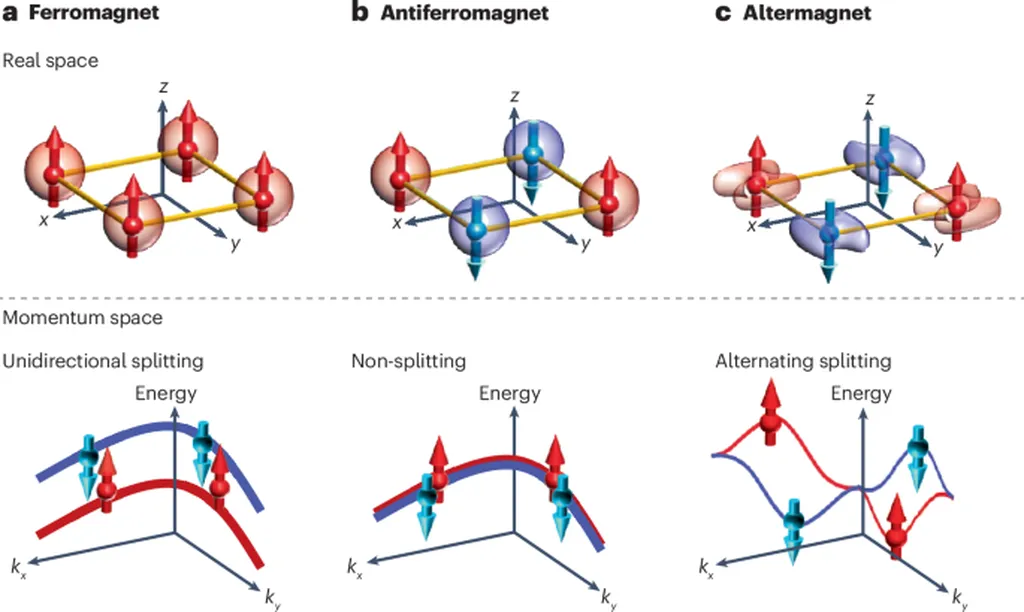
In the realm of energy and materials science, a team of researchers from the University of Science and Technology of China has made significant strides in understanding a new class of materials called altermagnets. These materials could potentially revolutionize the way we think about multiferroics, which are materials that exhibit both magnetic and electric properties. The team, led by Professor Tong Zhou, has been exploring the unique properties of perovskite altermagnets, with a particular focus on their behavior at the two-dimensional (2D) scale.
The researchers have discovered that altermagnets offer a new paradigm for multiferroics. Unlike conventional multiferroics, which rely on direct magnetoelectric coupling, altermagnets host a crystal-symmetry-mediated magnetoelectric interaction. This interaction is inherently more efficient and robust, making altermagnets a promising avenue for research. Among the various material platforms, layered perovskites stand out due to their structural diversity and synthetic versatility. However, the magnetoelectric properties of these materials at the 2D scale have remained largely unexplored until now.
The team systematically investigated the dimensional evolution of ferroelectric polarization and magnetism in perovskite systems through symmetry analysis. They found that altermagnetism can persist in the 2D limit, but it is strongly constrained by the magnetic configuration. Specifically, only the C-type antiferromagnetic order supports altermagnetism. This finding is crucial for the development of miniaturized, highly integrated devices that rely on these properties.
Furthermore, the researchers revealed that symmetry-restricted multimode couplings simultaneously govern ferroelectric polarization and altermagnetic spin splitting. This insight was gained through mode-decomposition calculations. The team also proposed several strategies to lift the magnetic-configuration constraint, thereby extending the range of viable altermagnetic systems. These strategies were developed in conjunction with first-principles calculations.
The practical applications of this research for the energy sector are significant. The development of next-generation electrically controlled spintronic and multiferroic devices could lead to more efficient and compact energy storage and conversion systems. These devices could also find applications in sensors, actuators, and other energy-related technologies. The research was published in the journal Nature Communications, a highly respected publication in the field of materials science and energy research.
This article is based on research available at arXiv.