
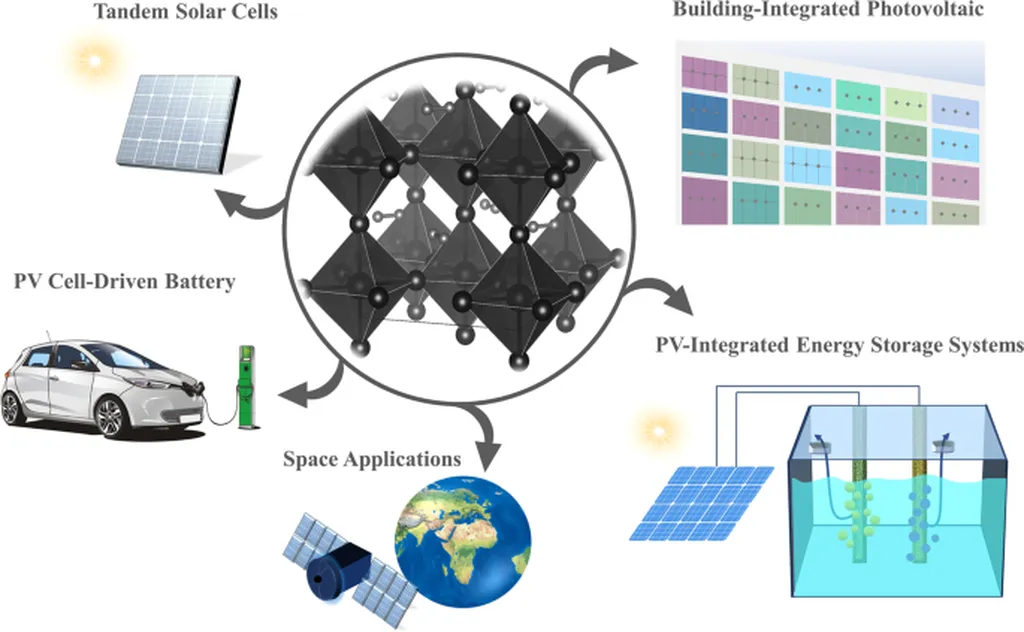
In the realm of energy materials, a recent study conducted by He Zhao and Eline M. Hutter from the University of Amsterdam has shed light on the potential of bismuth halide semiconductors for light-conversion applications. Their research, published in the Journal of Physical Chemistry Letters, focuses on tuning the properties of Cs3Bi2(Br1-xIx)9 semiconductors through halide alloying, which could have significant implications for the energy industry.
The study centers around the perovskite-inspired bismuth halide semiconductor Cs3Bi2Br9, which has garnered attention for its photoactive properties. However, its practical applications have been hindered by its modest sunlight absorption and strong exciton binding energy, which limit charge generation and separation. To address these challenges, the researchers employed a method called mechanochemical synthesis to substitute bromine (Br) with iodine (I) in the semiconductor’s structure, creating a series of Cs3Bi2(Br1-xIx)9 compositions.
Through a combination of X-ray diffraction and Raman analyses, the team confirmed that the halide substitution resulted in atomic-level mixing and revealed a crystallographic phase transition near the composition where x equals 0.8. The researchers then conducted absorption measurements on thin films of the various compositions to determine key properties such as the absorption coefficient, Urbach tail, and exciton binding energy. They found that the band gap of the material could be tuned from 2.59 to 1.93 eV by adjusting the iodine content, with the lowest exciton binding energies observed at x equals 0.6.
The study also delved into the charge carrier dynamics of the materials using transient absorption spectroscopy. The results suggested a weak correlation between recombination lifetime and Urbach energy, with the longest lifetimes observed in materials exhibiting the lowest disorder. These findings provide valuable insights into the design of stable bismuth halide semiconductors with optimized light absorption properties and charge carrier dynamics.
For the energy industry, these results could pave the way for more efficient and stable solar cells and other light-conversion devices. By tuning the properties of these semiconductors, it may be possible to enhance their performance and durability, making them more viable for large-scale energy applications. The research offers a promising avenue for further exploration and development in the field of energy materials.
Source: Journal of Physical Chemistry Letters, 2023.
This article is based on research available at arXiv.