
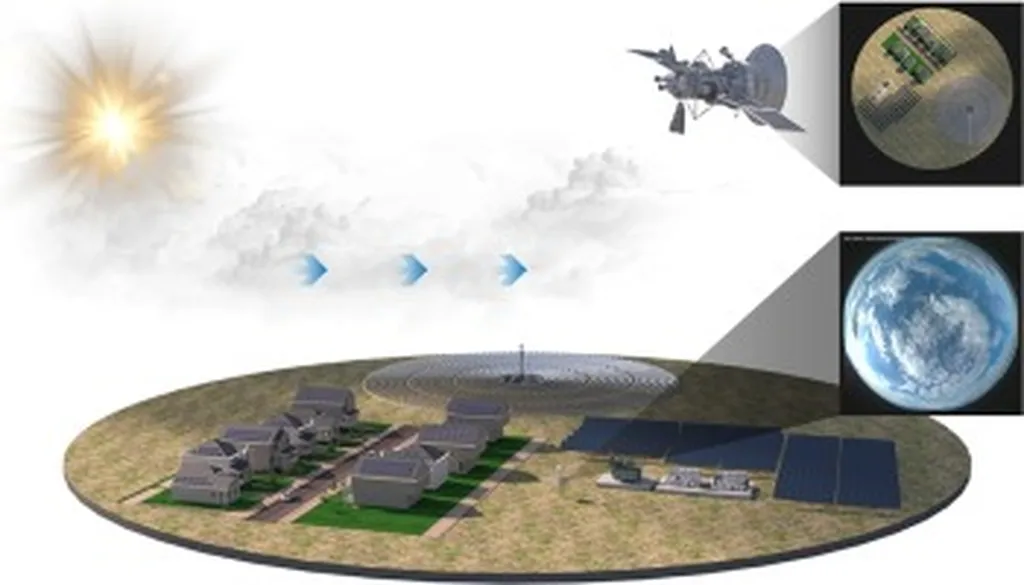
Researchers Luca Lanzilao and Angela Meyer from the Institute for Atmospheric and Climate Science at ETH Zurich have developed a novel framework for predicting photovoltaic (PV) power generation across Switzerland. Their work, published in the journal Remote Sensing of Environment, focuses on improving the accuracy and reliability of intraday solar power forecasts, which are crucial for integrating renewable energy into the grid.
The team evaluated seven different forecasting models, including satellite-based deep learning and optical-flow approaches, as well as physics-based numerical weather prediction models. These models were tested in both deterministic and probabilistic formulations. The forecasts were first validated against satellite-derived surface solar irradiance (SSI) data. The researchers then converted the irradiance fields into PV power predictions using machine learning models tailored to specific PV stations. This allowed them to compare their forecasts with actual production data from 6,434 PV stations across Switzerland.
The study is notable for being the first to investigate spatiotemporal PV forecasting at a national scale. The researchers also provided visualizations showing how mesoscale cloud systems influence national PV production on hourly and sub-hourly timescales. Their results indicate that satellite-based approaches generally outperformed the Integrated Forecast System (IFS-ENS), particularly at short lead times. Among the satellite-based models, SolarSTEPS and SHADECast delivered the most accurate SSI and PV power predictions. SHADECast also provided the most reliable ensemble spread, while the deterministic model IrradianceNet achieved the lowest root mean square error. Probabilistic forecasts from SolarSTEPS and SHADECast were found to be better-calibrated in terms of uncertainty.
The researchers noted that forecast skill tends to decrease with elevation. However, at a national scale, the satellite-based models demonstrated robust performance, forecasting the daily total PV generation with relative errors below 10% for 82% of the days in 2019-2020. This suggests that these models have significant potential for operational use in the energy sector.
For the energy industry, accurate PV power forecasting is essential for grid management, energy trading, and ensuring a stable supply of electricity. The ability to predict solar power generation with high precision can help grid operators balance supply and demand, integrate more renewable energy into the grid, and reduce reliance on fossil fuel-based power plants. The findings of this study could therefore have practical applications in improving the efficiency and reliability of solar power integration into national energy systems.
Source: Remote Sensing of Environment, Volume 287, March 2023, 113418
This article is based on research available at arXiv.