
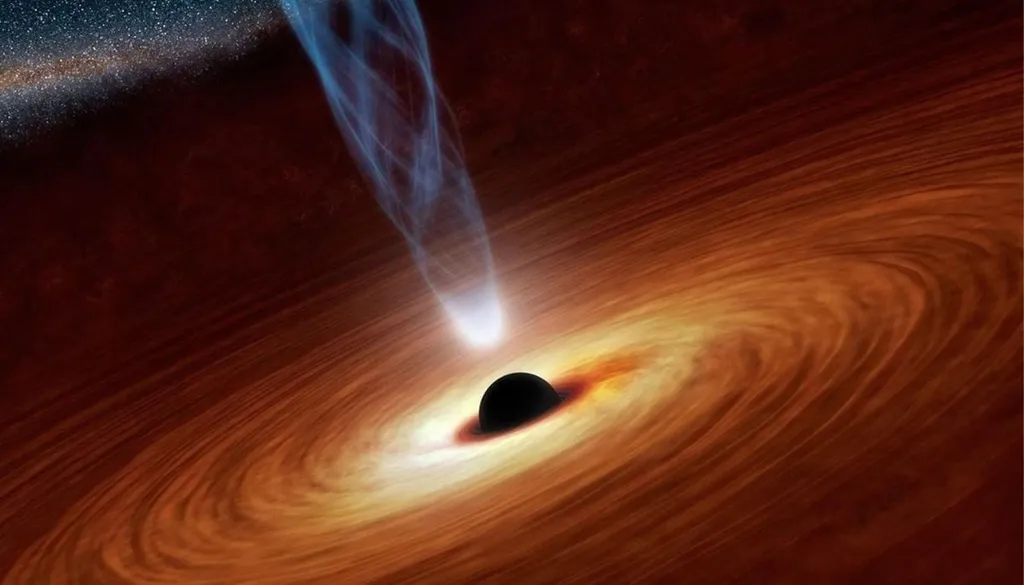
In the realm of theoretical physics and astrophysics, researchers Khadije Jafarzade, Saira Yasmin, and Mubasher Jamil from the University of the Punjab, Pakistan, have delved into the intriguing world of black holes and their optical properties. Their recent study, published in the journal Physical Review D, explores the behavior of a specific type of black hole within the framework of modified gravity theories and nonlinear electrodynamics.
The researchers investigated a static, spherically symmetric, electrically charged black hole in f(R) gravity coupled to Euler-Heisenberg nonlinear electrodynamics (NLED). F(R) gravity is a modified theory of general relativity where the gravitational Lagrangian is an arbitrary function of the Ricci scalar, R. Euler-Heisenberg NLED, on the other hand, describes the nonlinear effects of quantum electrodynamics in strong electromagnetic fields.
By analyzing the trajectories of photons in the spacetime around such black holes, the researchers found that the model parameters significantly influence light propagation. Specifically, they observed that increasing the electric charge and the parameter fR0 (a constant related to the f(R) gravity theory) leads to a wider range of lensed trajectories and photon rings. These are regions where light orbits the black hole multiple times before escaping, creating a distinctive ring-like structure in the observed image.
The study identified regions of parameter space where physically consistent black hole shadows exist. A black hole shadow is the dark region in the observed image of a black hole, caused by the bending of light rays as they pass near the black hole. The existence of a photon sphere—a set of light orbits that are bound to the black hole—and a shadow formed beyond it are crucial for the consistency of the model.
The researchers then constrained their model using observations from the Event Horizon Telescope (EHT) of the supermassive black hole M87*. They found that de Sitter black hole solutions, which have a positive cosmological constant, remain compatible with the observational data. In contrast, anti-de Sitter solutions, which have a negative cosmological constant, are disfavored for low electric charge and fR0 values greater than -1.
Finally, the study analyzed the energy emission rate of these black holes. The findings suggest that higher electric charge enhances black hole evaporation, while stronger nonlinear electrodynamics effects and larger values of fR0 suppress it. This has implications for the lifetime and evolution of such black holes.
While this research is primarily theoretical, it contributes to our understanding of black hole physics and the interplay between gravity and electromagnetism. Practical applications in the energy sector are not directly apparent, but the study of black holes and their properties can indirectly influence technologies such as advanced imaging techniques and our understanding of extreme gravitational fields. The research was published in Physical Review D, a peer-reviewed journal dedicated to the publication of fundamental research in all areas of theoretical and experimental particle physics.
This article is based on research available at arXiv.