
Researchers Lucien Jezequel, Loïc Herviou, and Jens Bardarson from the Institute of Science and Technology Austria have uncovered a significant phenomenon in non-Hermitian systems that could have implications for understanding and characterizing certain energy systems. Their work, published in the journal Physical Review Letters, sheds light on the differences between eigenvalue and eigenstate spectra in these systems, which could lead to improved methods for analyzing and designing energy technologies.
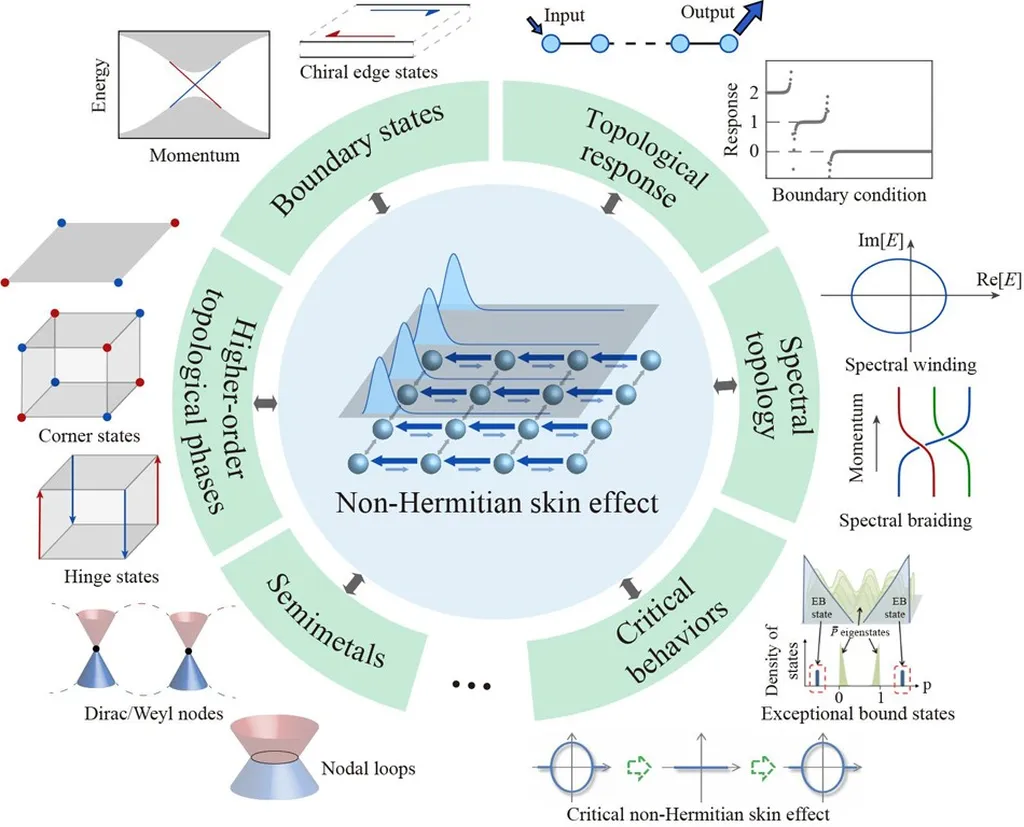
Non-Hermitian systems, which are systems that do not conserve energy, exhibit a unique spectral dichotomy not seen in Hermitian systems. This means that the eigenvalue spectrum and the eigenstate spectrum can differ significantly in the thermodynamic limit. The researchers explain that non-Hermitian Hamiltonians can support eigenstates that are not detected by eigenvalues. They demonstrate this using the unidirectional Hatano-Nelson model, which serves as a minimal realization and universal paradigm for this phenomenon.
Through exact analytical solutions, the researchers show that this model contains not only hidden modes but also multiple macroscopic hidden exceptional points. These points appear more generally in all systems with a non-trivial bulk winding. The framework developed by the researchers explains how apparent bulk-edge correspondence failures in models like the non-Hermitian SSH chain actually reflect the systematic inability of the eigenvalue spectrum to detect certain eigenstates in systems with a skin-effect.
The results of this research establish the limitations of the eigenvalue spectrum and suggest that the eigenstate approach can lead to improved characterization of non-Hermitian topology. This could have practical applications in the energy sector, particularly in the design and analysis of energy systems that involve non-Hermitian dynamics, such as certain types of lasers and optical systems. By better understanding and characterizing these systems, researchers can develop more efficient and effective energy technologies.
Source: Physical Review Letters
This article is based on research available at arXiv.