
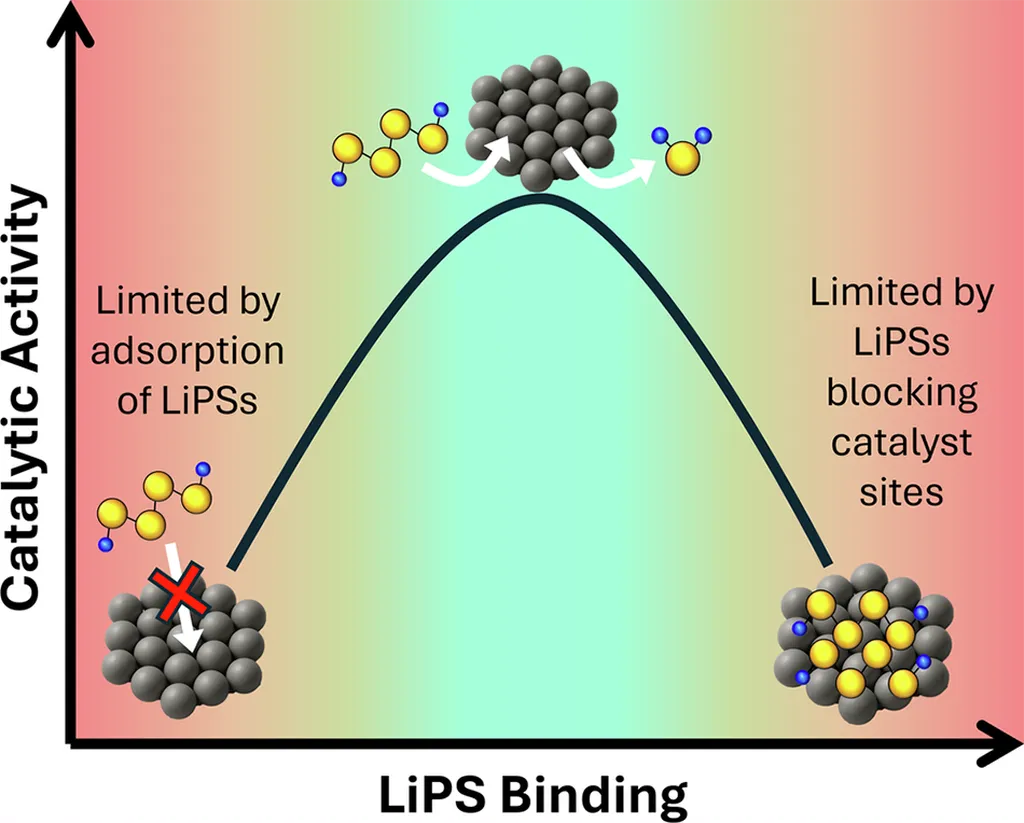
In a recent theoretical study, a team of researchers from the Federal University of Minas Gerais in Brazil has explored the potential of a novel two-dimensional gold allotrope, Goldene, as a catalyst for lithium-sulfur (Li-S) batteries. The team, led by Nicolas F. Martins and Luiz A. Ribeiro, used advanced computational methods to investigate how lithium sulfide and polysulfide clusters interact with Goldene.
The researchers employed first-principles density functional theory to examine the binding of various lithium-sulfide species to Goldene. They found that all the species studied, including Li2S, Li2S2, Li2S4, Li2S6, Li2S8, and S8, exhibited robust binding to the Goldene surface. The adsorption energies ranged from -4.29 to -1.90 eV, indicating strong interactions. Notably, the sulfur ring (S8) alone interacted much less strongly with the surface.
Charge density difference and Bader analyses revealed substantial charge transfer from the lithium-sulfide clusters to the Goldene substrate, with a maximum of 0.92 electrons for the lithium-rich clusters. This charge transfer induced polarization at the interface and shifted the work function of the material. Projected density-of-states calculations showed strong hybridization between the gold-d and sulfur-p states near the Fermi level, suggesting strong electronic coupling.
The researchers then constructed the reaction free-energy profile for the stepwise conversion of S8 to Li2S on Goldene. They found that the overall reaction is thermodynamically favorable, with an overall stabilization energy of -3.64 eV. The rate-determining barrier for the conversion of Li2S2 to Li2S was calculated to be 0.47 eV, indicating that Goldene could effectively mediate lithium polysulfide reactions.
This study, published in the Journal of Physical Chemistry C, suggests that Goldene could be a promising catalyst for Li-S batteries, which are considered a potential alternative to lithium-ion batteries due to their higher energy density. The strong binding and effective mediation of polysulfide reactions by Goldene could help address some of the challenges facing Li-S batteries, such as the shuttle effect, which reduces battery performance and lifespan. Further experimental studies are needed to validate these theoretical findings and explore the practical applications of Goldene in energy storage technologies.
This article is based on research available at arXiv.