
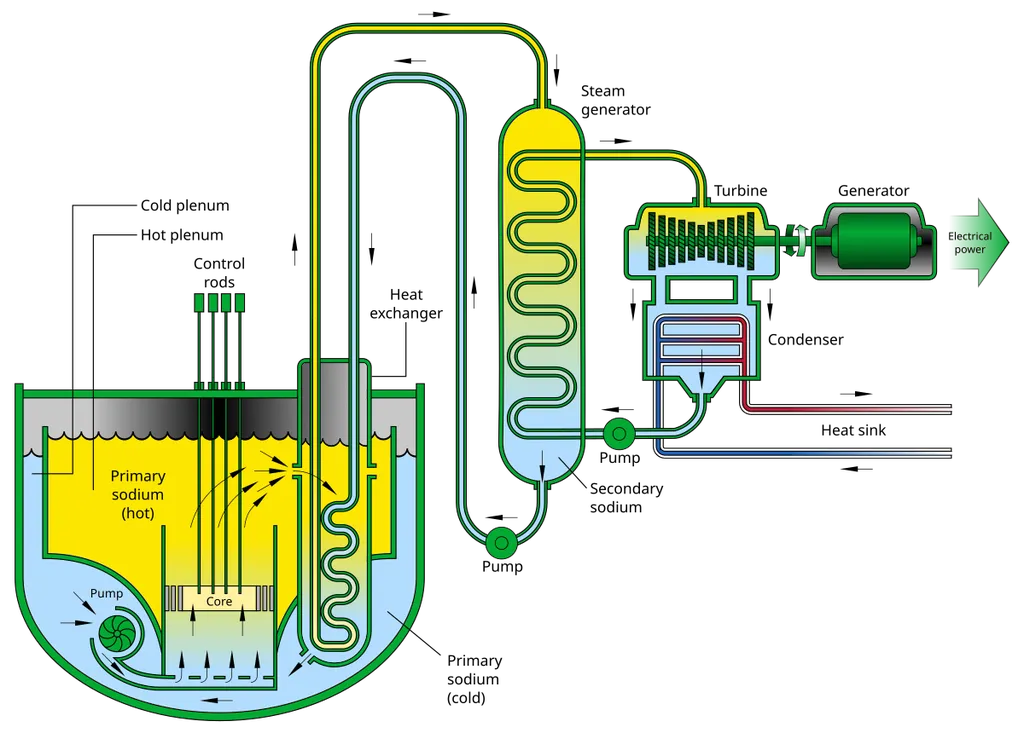
In the realm of nuclear energy, researchers from the French Alternative Energies and Atomic Energy Commission (CEA) are making strides in understanding the behavior of Sodium Cooled Fast Reactors (SFR), a type of fourth-generation nuclear reactor. The team, comprising B. Jourdy, D. Guenadou, N. Seiler, A. Labergue, and M. Gradeck, has been investigating scale effects in these reactors, particularly focusing on the rising jet that exits the core at low power. Their findings were recently published in the journal “Nuclear Engineering and Design.”
The researchers employed a scale effects methodology to study the behavior of the rising jet in SFR reactors. Due to the impracticality of building full-sized prototypes, most experiments are conducted on reduced-scale models. However, this approach can lead to scale effects, which are variations in physical phenomena that occur due to changes in the size of the system being studied.
To address this, the team used the SFR’s reduced-scale mock-up MICAS as a reference. They considered the dimensionless Navier-Stokes equations under Boussinesq’s approximation and applied the Vaschy-Buckingham theorem to identify the most relevant dimensionless numbers. Among these, the densimetric Froude number emerged as a critical parameter.
The researchers conducted experimental campaigns to measure velocity fields using Particle Image Velocimetry (PIV). Their analysis revealed that the mean pathway of the jet is dependent on the densimetric Froude number. Specifically, they observed a change in the jet’s behavior at a threshold value of 0.45. This finding also indicated that the jet’s rise before it impinges on the Upper Core Structure (UCS) is negligible.
The practical implications of this research for the energy sector are significant. Understanding the behavior of the rising jet in SFR reactors can enhance the design and safety of these systems. By accurately predicting the jet’s pathway, engineers can optimize the reactor’s layout and ensure that it operates within safe parameters. This research contributes to the ongoing efforts to develop advanced nuclear reactors that are safer, more efficient, and more sustainable.
In summary, the CEA team’s work on scale effects in SFR reactors provides valuable insights into the behavior of these systems. Their findings can help improve the design and safety of fourth-generation nuclear reactors, ultimately contributing to the advancement of the energy sector.
This article is based on research available at arXiv.