
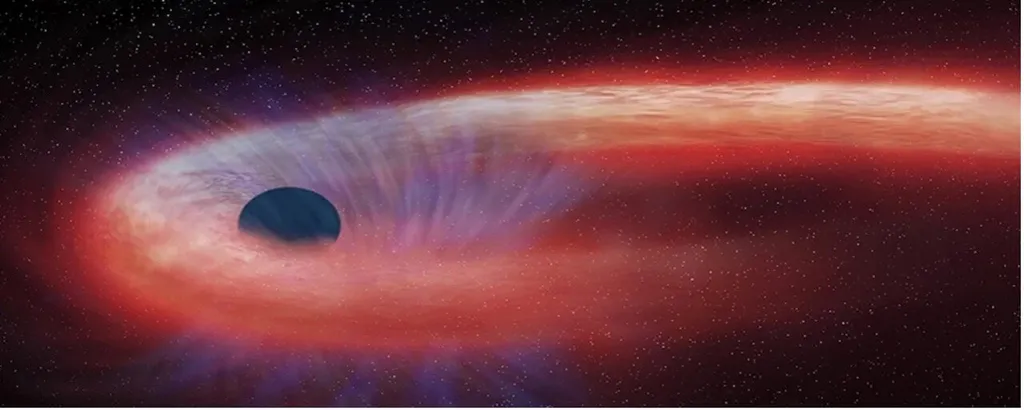
In the realm of astrophysics, a team of researchers led by Dr. Christopher Angus from the University of Edinburgh, along with colleagues from various institutions including Queen’s University Belfast, the University of California Berkeley, and the University of Warwick, have been delving into the complexities of tidal disruption events (TDEs). These events occur when a star ventures too close to a supermassive black hole and is torn apart by the black hole’s immense gravitational forces. The researchers have been exploring whether the light emitted from these events can reliably help us measure the masses of these quiescent supermassive black holes.
The team’s work, published in the journal Monthly Notices of the Royal Astronomical Society, focuses on the reliability of current TDE models in measuring black hole masses. TDE light curves, which are graphs of light output over time, are increasingly used to infer the masses of these black holes. However, most semi-analytic TDE models assume that the star is completely disrupted, which is not always the case. Theoretical expectations suggest that partial disruptions, where only part of the star is torn apart, are more common.
To test the robustness of current TDE models, the researchers studied three repeating partial TDEs (rpTDEs), where the same surviving stellar core produces multiple flares. They presented spectroscopic observations that established AT 2023adr as a rpTDE, making it the third such spectroscopically confirmed event. The team independently modeled the flares of these three rpTDEs using various methods, including fallback-accretion fits, stream-stream collision scaling relations, luminosity-based empirical relations, and cooling-envelope fits.
After accounting for statistical and model-specific systematics, the researchers found that all TDE models generally returned self-consistent black hole mass values between flares. These values were also broadly consistent with host-galaxy black hole mass proxies, recovering black hole masses to within 0.3-0.5 dex. However, the study also revealed limitations in the existing fallback model grids, as the models tended to converge towards unphysical stellar masses and impact parameters.
The research also highlighted the importance of light curve coverage, particularly in the near-UV range, for constraining model parameters. This has significant implications for interpreting the thousands of TDE light curves expected from upcoming surveys such as the Rubin Observatory’s Legacy Survey of Space and Time. The researchers found that without additional follow-up, black hole masses may be underestimated on average by 0.5 dex.
In the context of the energy industry, while this research may not have direct applications, it contributes to our broader understanding of the universe and the fundamental forces that govern it. A deeper understanding of black holes and their behavior can indirectly influence various fields, including energy research, by expanding our knowledge of the physical laws that underpin all phenomena. Moreover, the advanced modeling techniques and data analysis methods developed in this research can potentially be adapted for use in energy-related studies, such as predicting and managing complex systems.
This article is based on research available at arXiv.