
In the realm of energy journalism, it’s crucial to stay informed about cutting-edge scientific research that could potentially impact the energy sector. A recent study, led by Vera Berger from the Massachusetts Institute of Technology (MIT) and her team, including Erin Kara, Joheen Chakraborty, Megan Masterson, and Kevin Burdge, has shed light on a fascinating astronomical event that could have implications for our understanding of energy generation and variability in the universe.
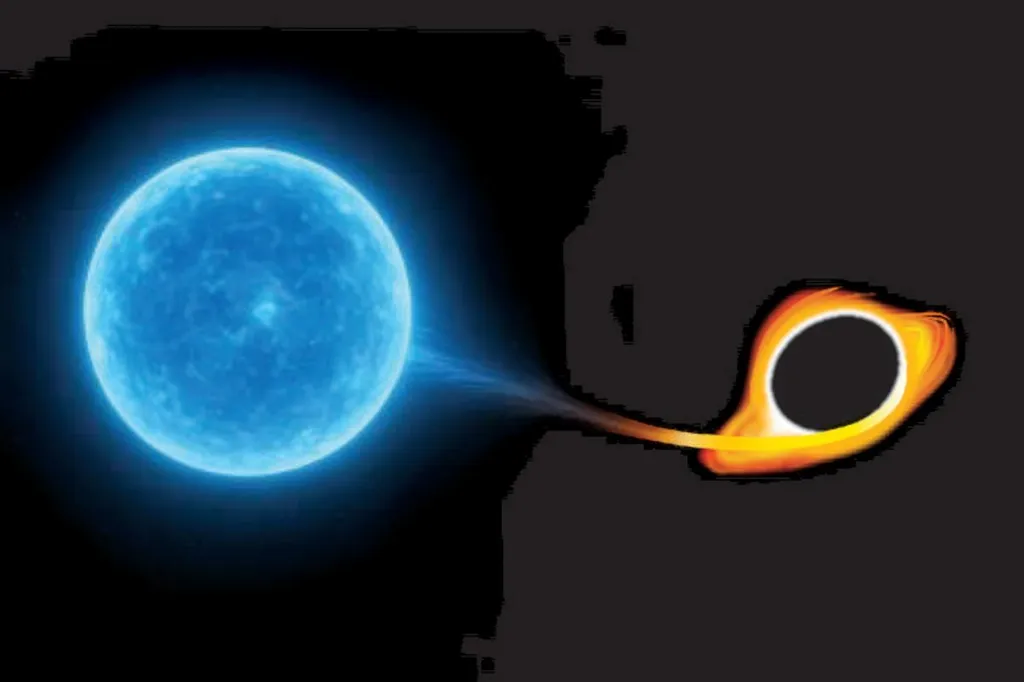
The researchers presented a five-year X-ray spectral and timing analysis of an optically selected Tidal Disruption Event (TDE) named AT2019teq. TDEs occur when a star passes too close to a supermassive black hole and is torn apart by the black hole’s gravitational forces, creating a bright flare that can be observed across multiple wavelengths. AT2019teq displayed extreme variability, with flux changes of up to an order of magnitude on timescales ranging from minutes to days. This variability is of particular interest to the energy sector, as understanding the mechanisms behind such extreme fluctuations could inform the development of more resilient and adaptable energy systems.
One of the most intriguing findings of this study was the detection of sub-mHz quasi-periodic oscillations in one epoch. These oscillations were tested for significance using MCMC-based red-noise simulations and were found to be significant at the 97% confidence level. The detection of such oscillations is rare in TDEs and could provide valuable insights into the physical processes occurring in the vicinity of supermassive black holes.
AT2019teq also exhibited a clear spectral evolution from a soft (blackbody-dominated) state to a hard (power-law-dominated) state. This transition was accompanied by a late-time radio brightening, which may be associated with the state transition. The researchers identified similarities between AT2019teq’s evolution and X-ray binary soft-to-hard state transitions, albeit at higher luminosity and much faster timescales. This comparison could help energy researchers better understand the behavior of compact objects and their potential as energy sources.
The study was published in the Astrophysical Journal, a prestigious journal in the field of astronomy and astrophysics. The research highlights the importance of continued observation and analysis of astronomical events, as they can provide valuable insights into the fundamental processes that govern the universe and, by extension, the energy sector. As we strive to develop more efficient and sustainable energy systems, understanding the behavior of extreme astrophysical phenomena could prove to be an invaluable resource.
This article is based on research available at arXiv.