
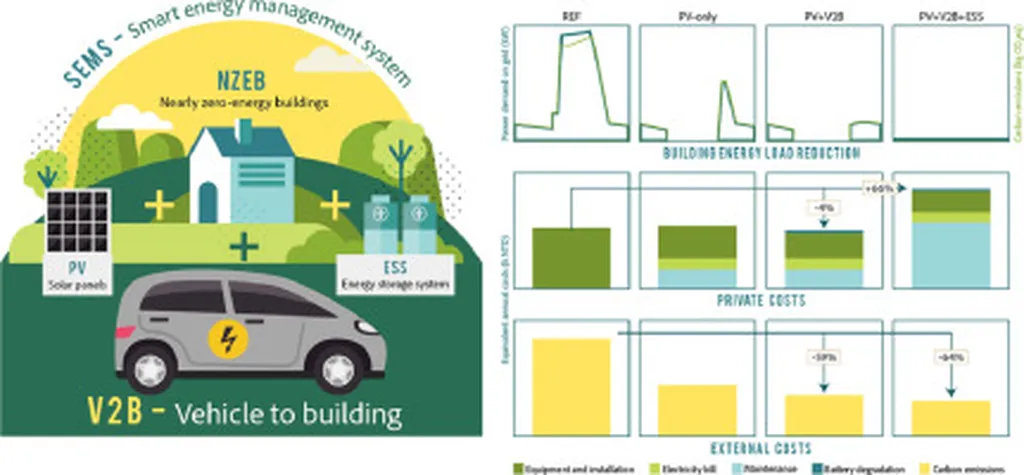
Researchers from Vanderbilt University and Nissan Advanced Technology Center – Silicon Valley have developed a new approach to optimize energy use in vehicle-to-building (V2B) systems, which integrate smart buildings and electric vehicles (EVs) connected to chargers at the building. This team, led by Ayan Mukhopadhyay and Abhishek Dubey, has proposed a method to manage energy use more efficiently, reducing costs under variable pricing and demand charge policies.
Vehicle-to-building systems use EVs as flexible energy reservoirs, allowing buildings to dynamically charge and discharge them to optimize energy use. The challenge lies in coordinating EV charging and discharging to minimize total electricity costs while meeting users’ charging requirements. This is complicated by fluctuating electricity pricing, long planning horizons, heterogeneous chargers, and user-specific battery levels at departure.
Existing approaches often model this setting as a single-shot combinatorial optimization problem. However, the researchers highlight critical limitations in prior work and instead model the V2B optimization problem as a Markov decision process (MDP), a stochastic control process. Solving the resulting MDP is challenging due to the large state and action spaces. To address these challenges, the researchers leverage online search to handle the large state space and use domain-specific heuristics to prune unpromising actions.
The researchers validated their approach using data from Nissan’s EV testbed. They found that their proposed framework significantly outperforms state-of-the-art methods. This research was published in the journal IEEE Transactions on Smart Grid.
The practical applications for the energy sector are significant. As the adoption of EVs increases, V2B systems can play a crucial role in managing energy use more efficiently. By optimizing the charging and discharging of EVs, buildings can reduce their electricity costs and contribute to a more stable and resilient grid. This research provides a promising approach to achieving these goals, offering a more sophisticated and effective method for managing V2B systems.
This article is based on research available at arXiv.