
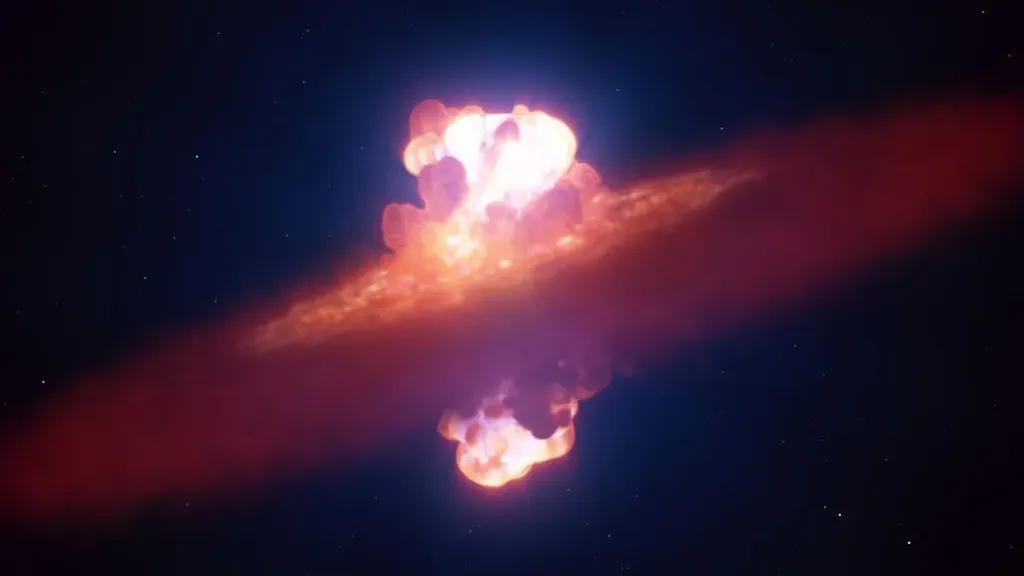
In the realm of astrophysics and energy research, Conor M. B. Omand, a researcher from the University of Leicester, has been delving into the intricate processes that follow some of the universe’s most powerful events: supernovae. His recent work, published in the Monthly Notices of the Royal Astronomical Society, focuses on the cooling mechanisms of supernovae driven by magnetars, which are highly magnetized neutron stars.
Omand’s research centers on the late-time infrared cooling in magnetar-driven supernovae. These supernovae are believed to be powered by a central magnetar engine, which can emit vast amounts of energy in the form of a pulsar wind nebula (PWN). This PWN can photoionize the surrounding supernova ejecta, leading to distinct spectroscopic signals, particularly in the infrared spectrum.
The study reveals that infrared cooling becomes significant around three years post-explosion and dominates the cooling process by six years. Specifically, the [Ne II] 12.8μm line is identified as the strongest coolant. The transition to infrared cooling is influenced by several factors, including the luminosity of the PWN, the mass of the ejecta, and the average photon energy of the PWN. Interestingly, the emission from [Ne II] 12.8μm increases with higher PWN luminosity and greater ejecta mass.
Initially, at one year post-explosion, cooling is dominated by optical lines of oxygen and sulfur. However, by three years, infrared lines of argon, nickel, and neon become prominent. By six years, optical cooling becomes almost negligible, with the supernova cooling primarily through mid- and far-infrared transitions.
One of the practical applications of this research for the energy sector lies in the potential for detecting these infrared emissions using the James Webb Space Telescope (JWST). JWST’s Mid-Infrared Instrument (MIRI) should be capable of detecting these lines out to a redshift of approximately 0.1. This capability could provide valuable insights into the late-time behavior of supernovae and their energy output, which can inform our understanding of stellar evolution and the life cycles of stars.
Furthermore, the study suggests that supernovae with higher magnetic fields transition to infrared cooling earlier. These infrared-dominated supernovae are also expected to exhibit strong emission from neutral atoms and emit strongly in the radio spectrum at sub-decade timescales. This information could be crucial for developing more accurate models of supernovae and their energy dynamics, which in turn can enhance our understanding of the universe’s energy budget and the role of supernovae in galactic evolution.
This article is based on research available at arXiv.