
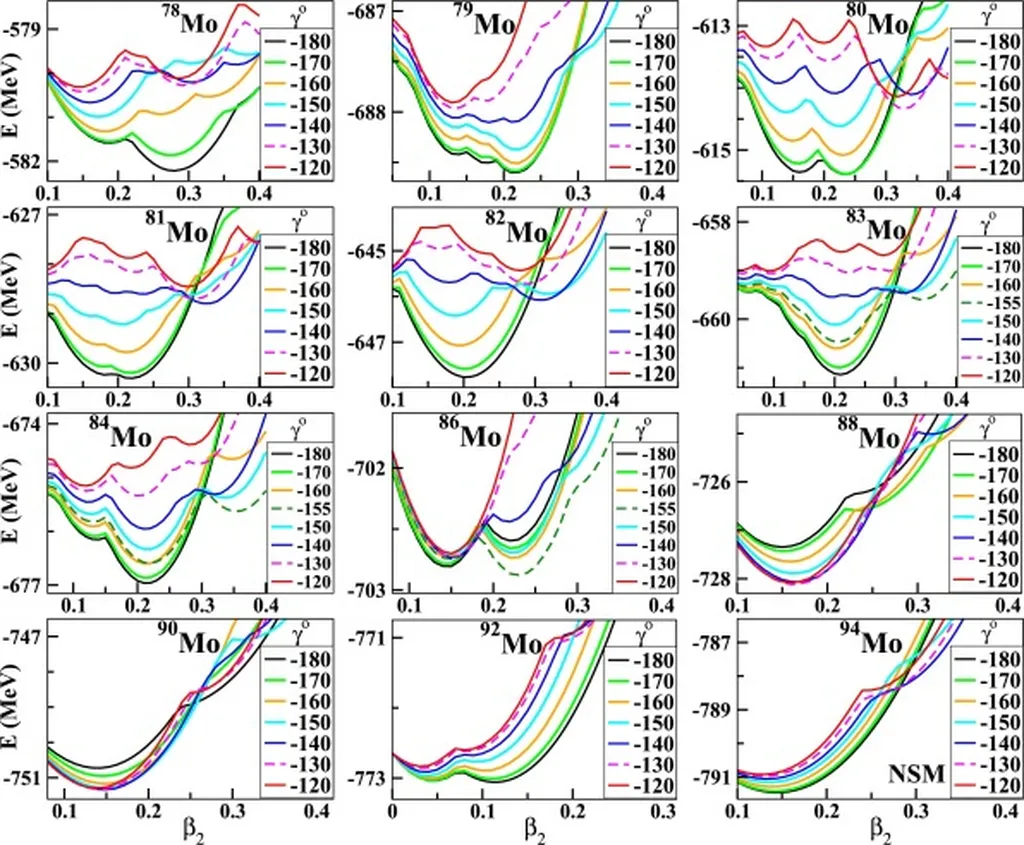
In the realm of nuclear physics, a team of researchers from the Department of Physics at Panjab University, Chandigarh, India, has been delving into the thermal evolution of shape coexistence in molybdenum (Mo) and ruthenium (Ru) isotopes. The team, comprising Mamta Aggarwal, Pranali Parab, A. Jain, and G. Saxena, has published their findings in the journal “Physical Review C,” a publication of the American Physical Society.
The study focuses on the temperature-driven shape dynamics of Mo and Ru isotopes, which are crucial in the rapid neutron-capture process, or r-process, a nucleosynthesis process that occurs in extreme astrophysical environments such as neutron star mergers and core-collapse supernovae. These isotopes are known for their rapid structural changes, shape instabilities, and shape coexistence, which significantly impact nuclear processes, decay modes, and lifetimes.
The researchers employed a statistical theoretical framework with a macroscopic-microscopic approach to investigate these phenomena. They found that at high temperatures, which can exist in stars or various nuclear reaction processes, these nuclei undergo a variety of shape and deformation changes due to thermal shell quenching effects. These changes influence the decay energies, or Q values, and eventually the lifetimes of the isotopes.
The study reveals that the structural changes, driven by the diminishing nuclear shell effects in hot nuclei, significantly impact the decay processes in the astrophysically relevant Mo-Ru region, especially around mass number A = 100. This research provides valuable insights into the behavior of these isotopes under extreme conditions, which can have implications for our understanding of nuclear reactions and processes in astrophysical environments.
While this research is primarily focused on nuclear physics, it can indirectly influence the energy sector, particularly in nuclear energy research. Understanding the behavior of these isotopes under extreme conditions can contribute to the development of advanced nuclear reactors and the improvement of nuclear waste management strategies. Furthermore, insights into the r-process can enhance our knowledge of the origin of heavy elements, which are crucial in various energy production and storage technologies.
In conclusion, the work of Aggarwal and her colleagues sheds light on the complex behavior of Mo and Ru isotopes under high temperatures, providing a deeper understanding of nuclear processes and their implications for astrophysics and, potentially, the energy sector.
This article is based on research available at arXiv.