
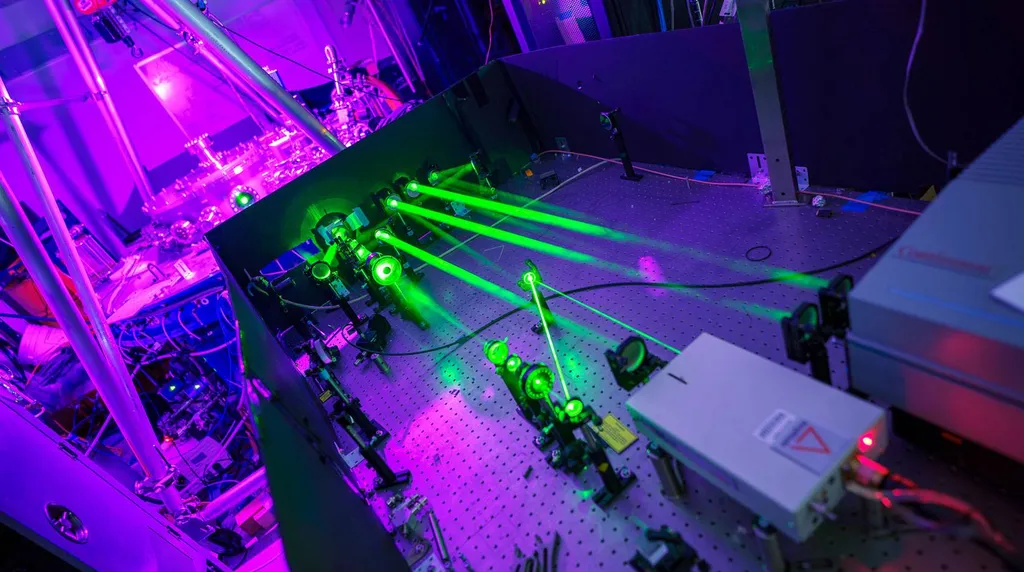
Researchers Jiayue Han, Vahid Mosallanejad, Ruihao Bi, and Wenjie Dou from the University of California, Irvine, have developed a new computational method to simulate molecular dynamics driven by two-frequency laser fields. Their work, published in the Journal of Chemical Physics, aims to improve the understanding and design of laser control protocols, which have potential applications in various energy-related fields.
The study focuses on two-frequency, or two-color, laser fields, which offer a versatile way to steer molecular dynamics. However, current theoretical tools for simulating these processes are limited in terms of reliability and scalability. To address this gap, the researchers developed a two-mode Floquet fewest switches surface hopping (two-mode F-FSSH) approach. This method operates within a mixed quantum-classical framework, allowing it to capture the complex interplay between electronic and nuclear dynamics driven by two-frequency laser fields.
The researchers validated their algorithm using three one-dimensional, two-state models: a Rabi model and two avoided-crossing scattering models. They benchmarked the electronic and nuclear dynamics against numerically exact results from split-operator calculations. The results showed good agreement across a broad range of field parameters and initial conditions, demonstrating the practicality of the two-mode F-FSSH approach.
The successful development and validation of the two-mode F-FSSH method pave the way for simulating and designing more effective two-frequency control protocols. These protocols could have applications in various energy sectors, such as laser-driven chemical reactions for energy storage or the development of more efficient solar cells. By providing a reliable and scalable tool for simulating laser-driven molecular dynamics, this research contributes to the advancement of laser control technologies in the energy industry.
Source: Han, J., Mosallanejad, V., Bi, R., & Dou, W. (2023). Two-Mode Floquet Fewest Switches Surface Hopping for Nonadiabatic Dynamics Driven by Two-Frequency Laser Fields. Journal of Chemical Physics, 158(12), 124105.
This article is based on research available at arXiv.