
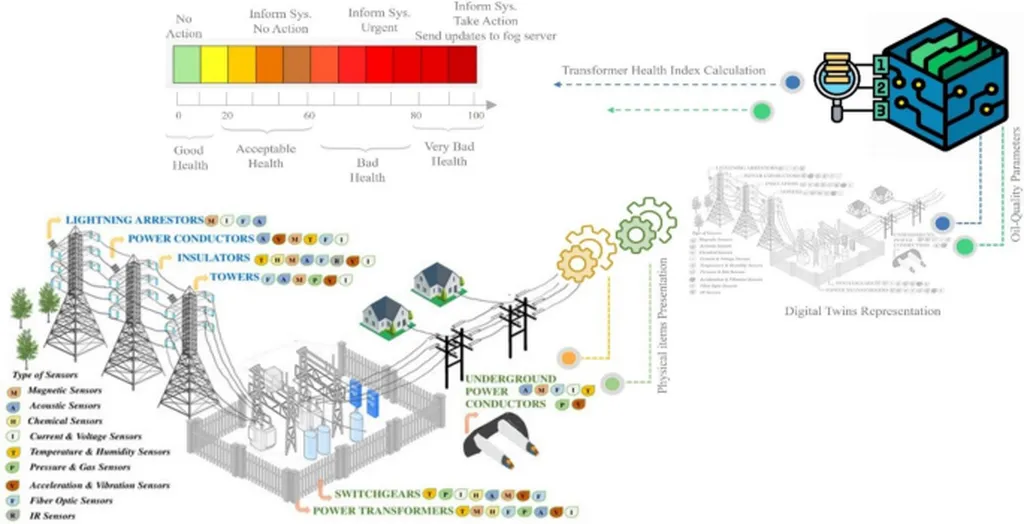
In the realm of energy journalism, a recent study has emerged that could significantly impact the way we manage and maintain critical infrastructure, particularly in the power sector. The research, conducted by Ibai Ramirez, Jokin Alcibar, Joel Pino, Mikel Sanz, and Jose I. Aizpurua from Tecnalia Research & Innovation, introduces a novel approach to predicting the degradation of insulation materials in transformers, a crucial component in power systems.
The study, published in the journal “Nature Communications,” focuses on enhancing the capabilities of Physics-Informed Neural Networks (PINNs). PINNs are a type of machine learning model that incorporates physical laws into their architecture, making them particularly suitable for applications in engineering and physics. However, their use in predicting the health and lifespan of equipment, known as Prognostics and Health Management (PHM), has been limited due to their inability to fully quantify uncertainty.
The researchers developed a new framework called Bayesian Physics-Informed Neural Networks (B-PINN). This approach combines Bayesian Neural Networks (BNNs) with physics-based residual enforcement and prior distributions, allowing for the joint modeling of two types of uncertainty: epistemic (uncertainty due to lack of knowledge) and aleatoric (uncertainty inherent in the system). This integration enables probabilistic inference within a physics-informed learning architecture, providing more comprehensive and accurate predictions.
The B-PINN framework was evaluated using data from transformer insulation ageing, validated with a finite-element thermal model and field measurements from a solar power plant. The results were compared against deterministic PINNs, dropout-based PINNs (d-PINNs), and alternative B-PINN variants. The proposed B-PINN demonstrated improved predictive accuracy and better-calibrated uncertainty estimates than the competing approaches.
The study also included a systematic sensitivity analysis to examine the impact of different boundary conditions, initial conditions, and residual sampling strategies on the accuracy, calibration, and generalization of the model. The findings highlight the potential of Bayesian physics-informed learning to support uncertainty-aware prognostics and informed decision-making in transformer asset management.
In practical terms, this research could revolutionize the way power companies manage their transformer fleets. By providing more accurate and reliable predictions of insulation material degradation, utilities can better plan maintenance schedules, reduce downtime, and extend the lifespan of their transformers. This not only improves the reliability of the power grid but also leads to significant cost savings.
Moreover, the B-PINN framework can be applied to other areas within the energy sector where uncertainty quantification is crucial, such as predicting the performance and degradation of batteries, solar panels, and wind turbines. The ability to make informed, risk-aware decisions based on robust predictive models is a valuable tool for any energy company looking to optimize its operations and assets.
In conclusion, the research conducted by Ramirez and his colleagues represents a significant advancement in the field of prognostic modeling for energy infrastructure. By integrating Bayesian principles with physics-informed neural networks, they have developed a powerful tool that can enhance the reliability and efficiency of power systems worldwide.
This article is based on research available at arXiv.