
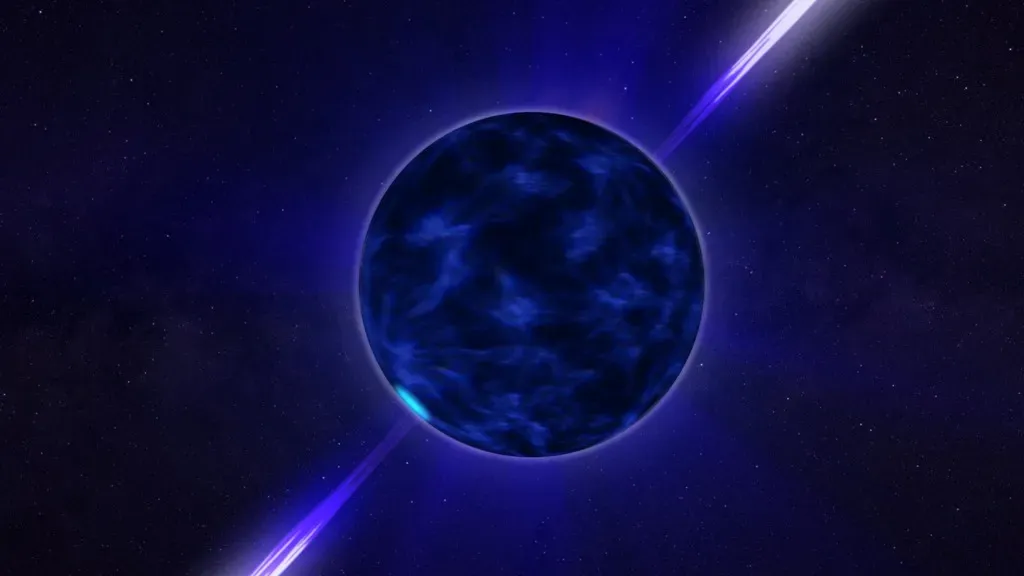
In the realm of astrophysics and nuclear physics, researchers Christian J. Krüger and Sebastian H. Völkel from the University of Potsdam have developed a novel approach to enhance our understanding of neutron stars, which could have implications for energy research, particularly in nuclear energy. Their work, published in the journal Physical Review Letters, focuses on improving the precision and accuracy of universal relations that describe the bulk properties of neutron stars.
Neutron stars, the remnants of massive stars that have exploded as supernovae, are incredibly dense and their properties are governed by the nuclear equation of state (EOS). However, the exact nature of this EOS is still unknown, leading to uncertainties in our understanding of neutron stars. Krüger and Völkel’s research aims to address this by combining simulation-based inference (SBI) with universal relations.
The researchers assembled a large dataset of neutron star bulk properties using multiple state-of-the-art EOS models. They then employed SBI to treat the uncertainties due to the unknown EOS as intrinsic, non-trivial noise. This approach allowed them to systematically explore universal relations in high-dimensional parameter spaces and identify the most promising parameter combinations.
One of the key findings of their research is a new universal relation that allows the radius of a neutron star to be determined as a function of its mass, fundamental mode, and one pressure mode. The researchers found that SBI can surpass the predictive power of this universal relation while also mitigating systematic errors. Moreover, they demonstrated that universal relations can be further calibrated to accurately mitigate systematic errors.
The practical applications of this research for the energy sector, particularly in nuclear energy, are still under exploration. However, a better understanding of neutron stars and the nuclear equation of state could potentially lead to advances in nuclear energy research, such as improved nuclear reactor designs or more accurate models for nuclear waste management. The research was published in Physical Review Letters, a prestigious journal in the field of physics.
This article is based on research available at arXiv.