
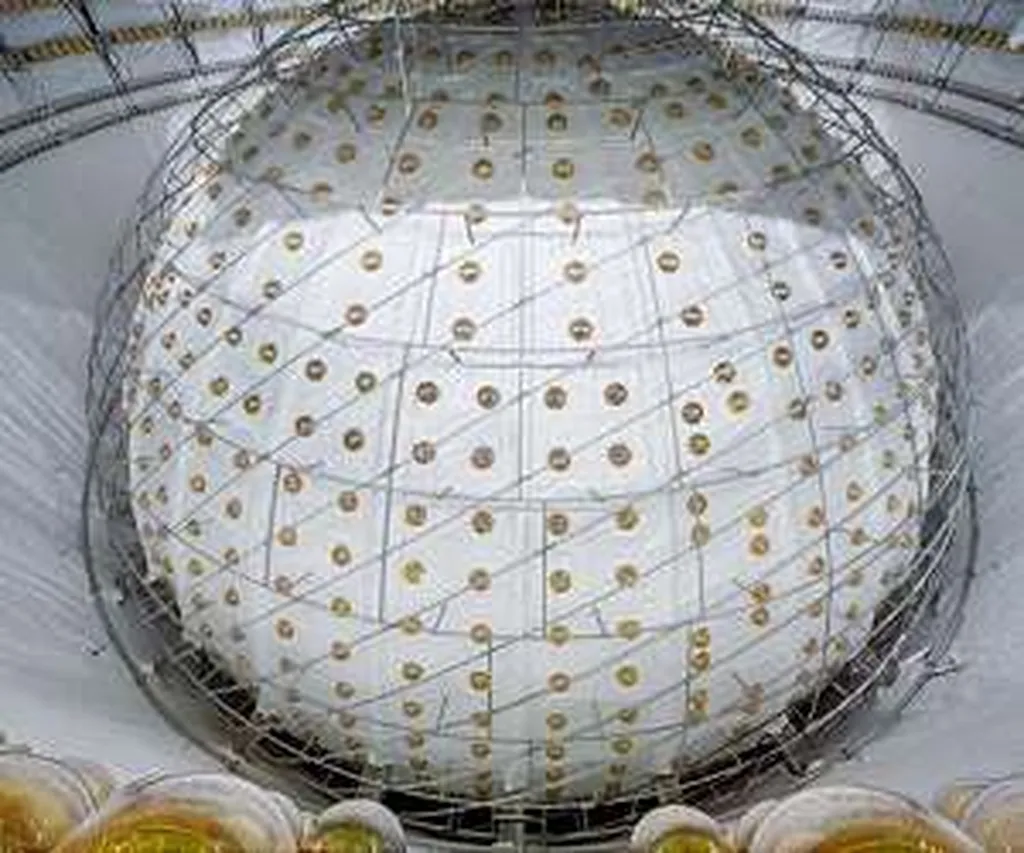
In the realm of energy and particle physics, researchers C. V. Ventura and Saul J. Panibra Churata from the JUNO collaboration have been delving into the potential of the Jiangmen Underground Neutrino Observatory (JUNO) to detect a rare phenomenon: the conversion of solar neutrinos into antineutrinos. Their work, published in the journal Physical Review D, explores the implications of this research for understanding neutrino properties and solar magnetic fields, which could indirectly benefit the energy sector’s pursuit of advanced, fusion-based power sources.
Neutrinos are fundamental particles that play a crucial role in nuclear reactions, including those that power the sun. The JUNO experiment, located in China, is designed to study these elusive particles in detail. Ventura and Churata investigated JUNO’s ability to detect solar neutrinos converting into antineutrinos through a process called spin-flavor precession (SFP). This phenomenon is influenced by the sun’s magnetic fields and could provide insights into the fundamental properties of neutrinos, such as their magnetic moment.
The researchers focused on two energy windows: 1.8–16.8 MeV and 8.0–16.8 MeV. They found that JUNO’s sensitivity to solar antineutrino flux in the higher energy window (8.0–16.8 MeV) is particularly noteworthy. In this range, JUNO could potentially detect an antineutrino flux as low as 4.01×10^1 cm^-2 s^-1 and a conversion probability as low as 2.07×10^-5, normalized to the expected solar neutrino flux from the Standard Solar Model (SSM). These findings suggest that JUNO could achieve sensitivities comparable to the most stringent astrophysical limits currently known.
Moreover, the researchers assessed JUNO’s potential to constrain the neutrino magnetic moment (NMM), a property that could reveal new physics beyond the Standard Model of particle physics. Assuming transverse solar magnetic fields of 50 and 100 kG, they found that JUNO could constrain the NMM to 7.27×10^-11 and 3.64×10^-11 Bohr magnetons, respectively, in the high-energy window. These constraints are competitive with current results, highlighting JUNO’s potential to advance our understanding of neutrino properties.
For the energy industry, this research is a stepping stone towards better understanding the fundamental processes that drive the sun and other potential fusion reactions. While direct applications may be distant, the insights gained from experiments like JUNO could inform the development of fusion energy technologies, which promise a clean, virtually limitless power source. The practical applications of this research are not immediate, but the foundational knowledge it provides is invaluable for the long-term pursuit of advanced energy technologies.
In summary, Ventura and Churata’s work demonstrates that the JUNO experiment has the potential to significantly contribute to our understanding of solar neutrinos, antineutrinos, and the fundamental properties of neutrinos. While the direct impact on the energy sector may be indirect and long-term, the insights gained from this research could pave the way for future advancements in fusion energy technologies. The research was published in Physical Review D, a peer-reviewed journal dedicated to the publication of fundamental research in the areas of particles, fields, gravitation, and cosmology.
This article is based on research available at arXiv.