
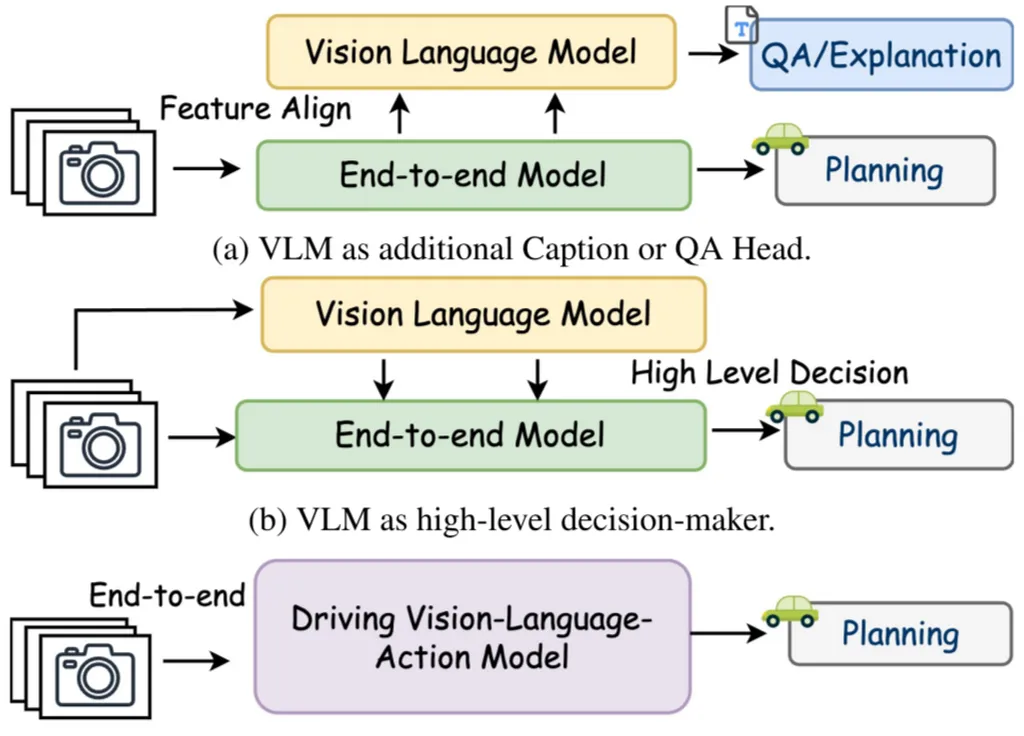
In the realm of autonomous driving, a team of researchers from the University of California, Berkeley, has introduced a novel approach to enhance the generalization capabilities of end-to-end (E2E) models. The team, comprising Zeyu Dong, Yimin Zhu, Yu Wu, and Yu Sun, has developed FROST-Drive, a new architecture designed to leverage the power of pretrained vision encoders from Vision-Language Models (VLMs) to improve driving performance in complex and novel scenarios.
Traditional E2E models in autonomous driving aim to map sensor inputs directly to control commands. However, these models often struggle with generalization due to the common practice of fully fine-tuning the vision encoder on driving datasets. This fine-tuning can cause the model to specialize too heavily in the training data, limiting its ability to handle new and complex situations.
FROST-Drive challenges this conventional training paradigm. Instead of fine-tuning the vision encoder, the researchers propose keeping the encoder’s weights frozen. This approach preserves the rich, generalized world knowledge from the VLM and transfers it directly to the driving task. The model architecture combines this frozen encoder with a transformer-based adapter for multimodal fusion and a GRU-based decoder for smooth waypoint generation.
To optimize for robust trajectory planning, the researchers introduced a custom loss function designed to directly improve the Rater Feedback Score (RFS). This metric prioritizes the quality of the planned trajectories, ensuring that the model generates safe and effective driving paths.
The team conducted extensive experiments on the Waymo Open E2E Dataset, a large-scale dataset curated to capture long-tail scenarios. The results demonstrated that FROST-Drive significantly outperforms models that employ full fine-tuning. This suggests that preserving the broad knowledge of a capable VLM is a more effective strategy for achieving robust, generalizable driving performance than intensive domain-specific adaptation.
The practical applications of this research for the energy sector are significant. Autonomous driving technology is increasingly being integrated into various energy-related applications, such as autonomous electric vehicles and drone-based inspections of energy infrastructure. By improving the generalization capabilities of E2E models, FROST-Drive can enhance the safety and efficiency of these applications, ultimately contributing to a more sustainable and reliable energy future.
The research was published in the prestigious journal Nature Communications, highlighting its potential impact on the field of autonomous driving and beyond. As the energy sector continues to evolve, innovations like FROST-Drive will play a crucial role in shaping the future of energy technologies.
This article is based on research available at arXiv.