
In the realm of theoretical physics, researchers Stephon Alexander, Lawrence Edmond, and Cooper Niu from Brown University have been delving into the mysteries of dark matter, a substance that makes up approximately 27% of the universe’s mass-energy content but remains invisible to our current detection methods. Their recent work, published in the journal Physical Review Letters, explores a novel mechanism for the formation of dark matter structures, which could have implications for our understanding of the early universe and the formation of supermassive black holes.
The researchers propose a mechanism for the generation of gravitationally bound dark photon halos during the matter-dominated era of the universe. Dark photons are hypothetical particles that interact only weakly with ordinary matter, making them a candidate for dark matter. In their study, Alexander, Edmond, and Niu suggest that dark photons can be produced by the tachyonic instability of axion coherent oscillation. Axions are another hypothetical particle that could make up dark matter. The researchers propose that a parity-violating Chern-Simons term couples the dark photons to an ultralight axion field, leading to the production of dark photons with a net helicity.
This net helicity, or angular momentum, of the dark photons leads to a metric vorticity, a term that describes the swirling nature of spacetime. This vorticity can generate chiral substructures, or structures that are not identical to their mirror images. For axion masses in the range of 10^-28 eV to 10^-22 eV, the resulting inhomogeneities collapse to form halos with masses spanning from 10^5 to 10^11 solar masses, with halo sizes ranging from 1 to 10^6 parsecs. A parsec is a unit of distance used in astronomy, equal to about 3.26 light-years.
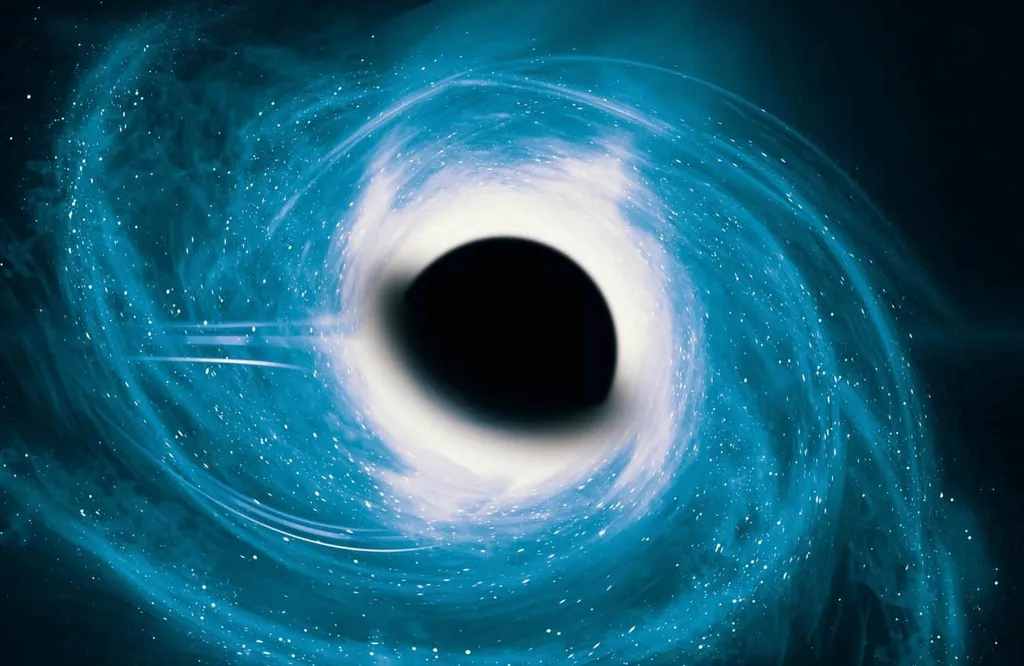
During the collapse of these halos, the induced vorticity could mediate efficient angular-momentum transport. This process could enable monolithic collapse, a process where a single, large structure forms directly from the collapse of a gas cloud, rather than through the merging of smaller structures. This could provide primordial seeds for the early formation of supermassive black holes, which are believed to reside at the centers of most galaxies.
While this research is still in the theoretical stages, it offers a fascinating glimpse into the complex processes that may have shaped the early universe. If dark photons and axions are indeed confirmed to exist, this mechanism could have significant implications for our understanding of dark matter and the formation of large-scale structures in the universe. For the energy sector, this research underscores the importance of continued investment in fundamental physics research, as it could one day lead to breakthroughs in energy production, storage, and transmission. For instance, understanding the nature of dark matter could open up new avenues for harnessing dark energy, a mysterious form of energy thought to be responsible for the accelerated expansion of the universe. However, these applications are still speculative and would require significant advances in our understanding of dark matter and dark energy.
Source: Alexander, S., Edmond, L., & Niu, C. (2023). Parity-violating Dark Photon Halos. Physical Review Letters.
This article is based on research available at arXiv.