
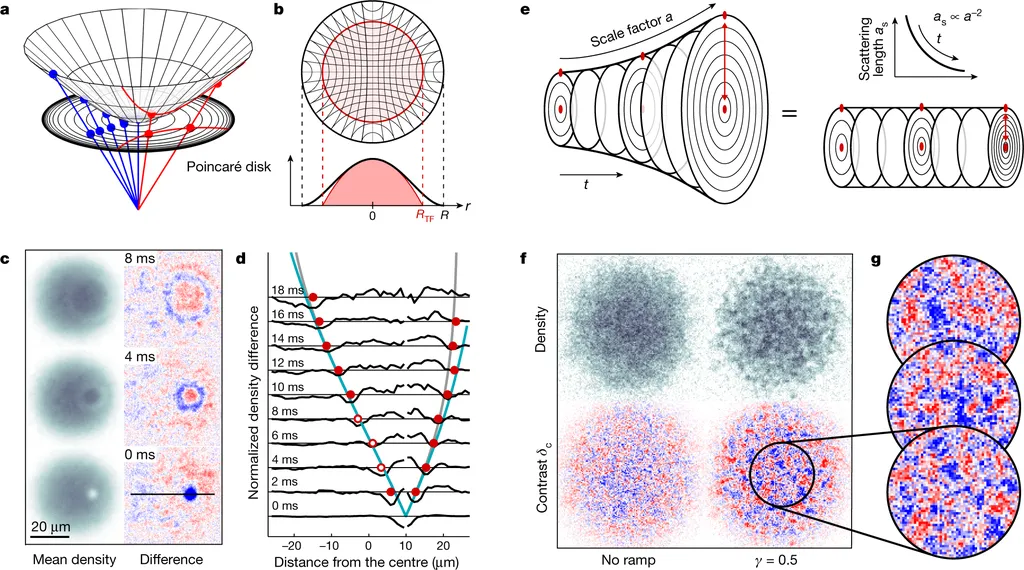
Researcher T. A. Petrosyan from the Yerevan State University in Armenia has delved into the intriguing world of quantum field theory and geometry, exploring how spatial curvature and topology can influence the vacuum state of a charged scalar field. This research, published in the journal Physical Review D, offers insights that could have implications for understanding fundamental physics and potentially even energy-related phenomena.
The study focuses on a (2+1)-dimensional Beltrami pseudosphere, a surface with constant negative curvature. Petrosyan investigates how the properties of the vacuum state of a scalar field change under different conditions, specifically when the field obeys a quasiperiodicity condition with constant phase. The vacuum expectation values (VEVs) of the field squared and the energy-momentum tensor are key metrics in this analysis, providing important local characteristics of the vacuum state.
The research reveals that the contributions to the VEVs from geometry with an uncompactified azimuthal coordinate are divergent, meaning they grow infinitely large. However, when the azimuthal coordinate is compactified—essentially wrapped into a finite loop—the contributions become finite and can be analyzed both numerically and asymptotically. For small values of the proper radius of the compactified dimension, the leading terms of the topological contributions are independent of the field mass and curvature coupling parameter, increasing according to a power-law. In contrast, for larger values of the proper radius, the VEVs decay following a power-law, except in the special case of a conformally coupled massless field, where the behavior differs.
One notable finding is that the radial and azimuthal stresses, components of the energy-momentum tensor, increase in absolute value, unlike the VEV of the field squared and the vacuum energy density. This implies that the effects of nontrivial topology are particularly strong for the stresses at small values of the radial coordinate. This could have implications for understanding the behavior of fields in curved and compactified spaces, potentially offering new insights into the fundamental nature of energy and matter in such environments.
While the immediate practical applications to the energy sector may not be clear, this research contributes to the broader understanding of quantum field theory in curved spaces. Such knowledge could eventually inform the development of advanced energy technologies, particularly those involving exotic states of matter or novel geometries. For now, the study serves as a stepping stone in the ongoing exploration of the interplay between geometry and quantum fields, paving the way for future discoveries that might one day revolutionize energy science.
This article is based on research available at arXiv.