
In the realm of high-energy physics, researchers are continually probing the boundaries of our understanding, seeking evidence of phenomena that extend beyond the well-established Standard Model. Among these explorers is Normunds Ralfs Strautnieks, a researcher affiliated with the ATLAS and CMS collaborations at CERN. Their recent work focuses on investigating lepton flavor symmetry and violation using top quarks, a topic of significant interest in the particle physics community.
Lepton flavor universality (LFU) is a principle that suggests that the interactions of the three types of charged leptons—electrons, muons, and tau particles—should be identical, except for differences due to their masses. Any deviation from this universality could indicate the presence of new physics beyond the Standard Model. Similarly, charged lepton flavor violation (cLFV) refers to processes where a lepton of one flavor transforms into another, a phenomenon that is forbidden in the Standard Model but could occur in certain BSM theories.
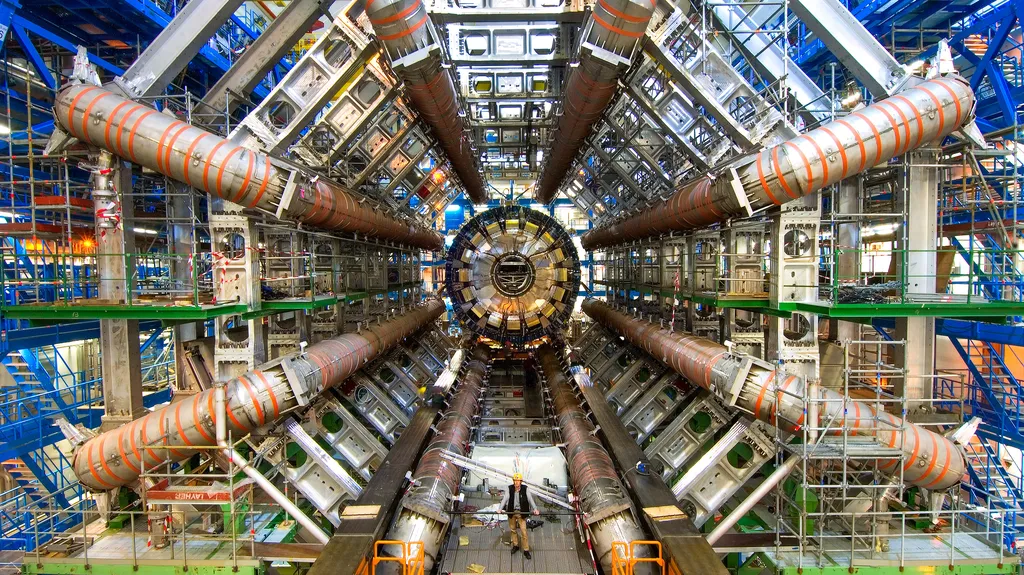
The Large Hadron Collider (LHC) at CERN provides an ideal environment for these investigations, particularly through the abundant production of top quark pairs. The high precision measurements of LFU ratios and searches for cLFV signatures using the Run2 dataset, which includes up to 139 inverse femtobarns of data collected at a center-of-mass energy of 13 TeV, have yielded intriguing results. These findings were recently presented by the ATLAS and CMS collaborations, offering new insights into the fundamental nature of particle interactions.
The practical applications of this research for the energy sector, while not immediately apparent, could be profound. A deeper understanding of the fundamental forces and particles could lead to advancements in energy production and storage technologies. For instance, the development of new materials or processes inspired by discoveries in particle physics could enhance the efficiency and sustainability of energy systems. Additionally, the computational and data analysis techniques developed for high-energy physics experiments often find applications in other fields, including energy research.
The research conducted by Normunds Ralfs Strautnieks and their colleagues was published in a recent issue of the journal Physical Review D, a prestigious publication in the field of particle physics. As the scientific community continues to explore the mysteries of the universe, the findings from these investigations will undoubtedly contribute to our collective knowledge and pave the way for future technological advancements.
This article is based on research available at arXiv.