
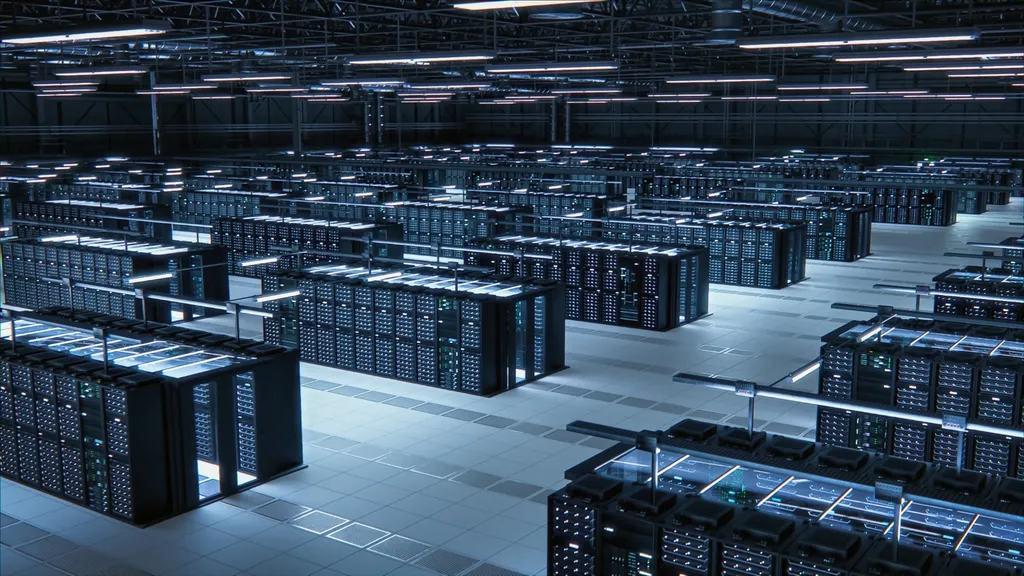
Researchers from the University of California, Berkeley, and the University of Texas at Austin have developed a novel polarization controller that could significantly improve the performance of data-center interconnects (DCIs), which are crucial for supporting the increasing demands of artificial intelligence and other data-intensive applications.
The team, led by Professor Ming Tang, has created the first integrated polarization controller using thin-film lithium tantalate (TFLT). This device enables reset-free polarization tracking at speeds of up to 2 megarads per second (Mrad/s), which is more than double the current state-of-the-art. The four-stage electro-optic device exhibits low polarization-dependent loss (PDL) below 0.3 dB, a half-wave voltage below 2.5 V, high modulation bandwidth, and negligible DC drift.
To accommodate the finite tuning range of integrated phase shifters, the researchers developed a finite-boundary gradient-descent (FBGD) control algorithm. This algorithm ensures reset-free state-of-polarization (SOP) evolution with no phase jump, which is critical for maintaining stable coherent reception in self-homodyne coherent (SHC) transmission systems.
The adaptive polarization controller (APC) was validated through both standalone polarization-tracking measurements and a dual-polarization 16-QAM SHC 400-Gbps transmission system. The results showed that transient polarization disturbances can be tracked at speeds up to 2 Mrad/s, while stable reset-free operation under continuous polarization disturbances is maintained up to 1 Mrad/s. The pre-forward error correction (FEC) bit-error rates remained below the hard-decision FEC (HD-FEC) threshold under realistic DCI conditions and lightning-scale polarization disturbances.
This research, published in the journal Nature Photonics, establishes TFLT as a new platform for ultrafast, low-power, reset-free, and drift-free polarization control in coherent optical interconnects and beyond. The practical applications of this technology include improving the bandwidth, latency, and energy efficiency of DCIs, which are essential for supporting the rapid escalation of computing power driven by large-scale artificial intelligence.
In the energy sector, this technology could be used to improve the performance of fiber-optic communication systems used in smart grids and other energy infrastructure. By enabling more efficient and reliable data transmission, this technology could help to optimize energy distribution, reduce losses, and improve overall system performance. Additionally, the low-power and high-speed capabilities of this technology could be leveraged to develop more energy-efficient data centers and other computing infrastructure, which are critical for supporting the growing demand for data-intensive applications.
This article is based on research available at arXiv.