
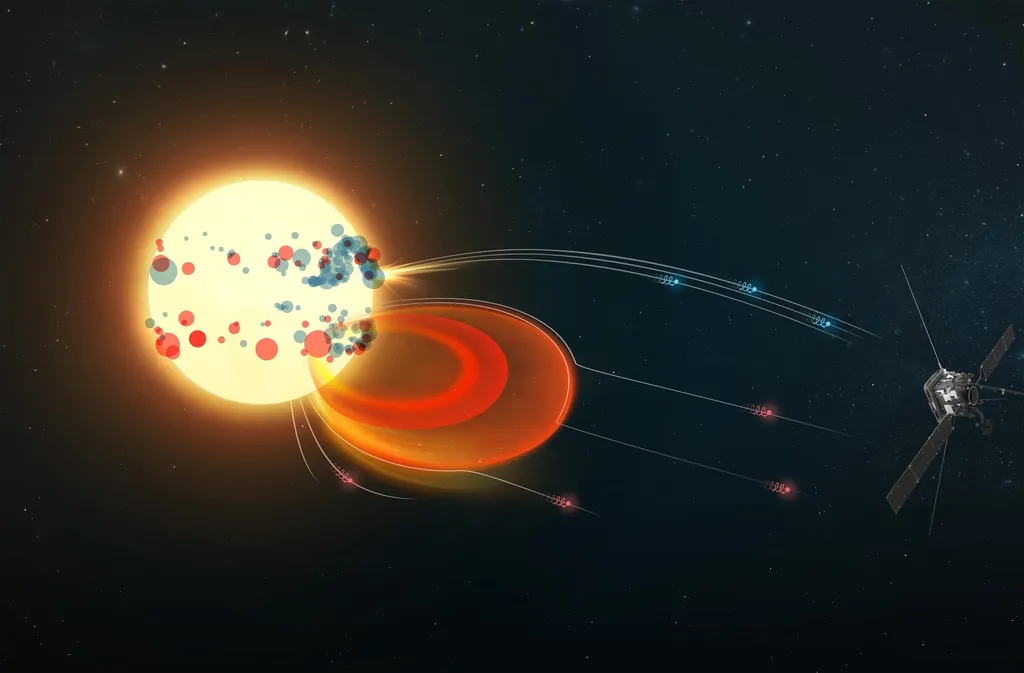
In the realm of space-based solar observations, a team of researchers from the University of Minnesota, the University of California, Berkeley, and other institutions has developed an innovative data acquisition system for the FOXSI-4 and FOXSI-5 sounding rocket experiments. These missions aim to capture high-sensitivity, high-dynamic-range images of solar flares using direct X-ray focusing optics.
The researchers, led by Shunsaku Nagasawa from the University of Minnesota and including Athanasios Pantazides, Kristopher Cooper, and others, have published their findings in a recent study. The team designed a modular data acquisition (DAQ) network architecture based on SpaceWire and the Remote Memory Access Protocol (RMAP). This architecture is crucial for managing the high photon flux from solar flares and accommodating diverse detector types, including CMOS sensors, CdTe double-sided strip detectors, and a Quad-Timepix3 detector.
The modular design allows for fast, reliable, and scalable communication among various onboard components, such as detectors, readout boards, onboard computers, and telemetry systems. This approach not only simplifies integration and reduces complexity but also supports distributed development among collaborating institutions. The researchers developed FPGA-based readout boards (SPMU-001 and SPMU-002) to facilitate high-speed data transfer and flexible instrument control. Additionally, a real-time ground support system was created to handle telemetry and command operations during flight, enabling live monitoring and adaptive configuration of onboard instruments.
The FOXSI-4 mission, launched on April 17, 2024, successfully achieved the first direct focusing observation of a GOES M1.6 class solar flare. The same architecture is being adopted for the upcoming FOXSI-5 mission, scheduled for launch in 2026. This innovative DAQ system demonstrates the potential for advanced data acquisition and communication technologies in space-based solar observations, offering valuable insights for the energy industry in understanding and predicting solar activities that can impact space weather and satellite operations.
Source: The research was published in the journal Space Science Reviews.
This article is based on research available at arXiv.