
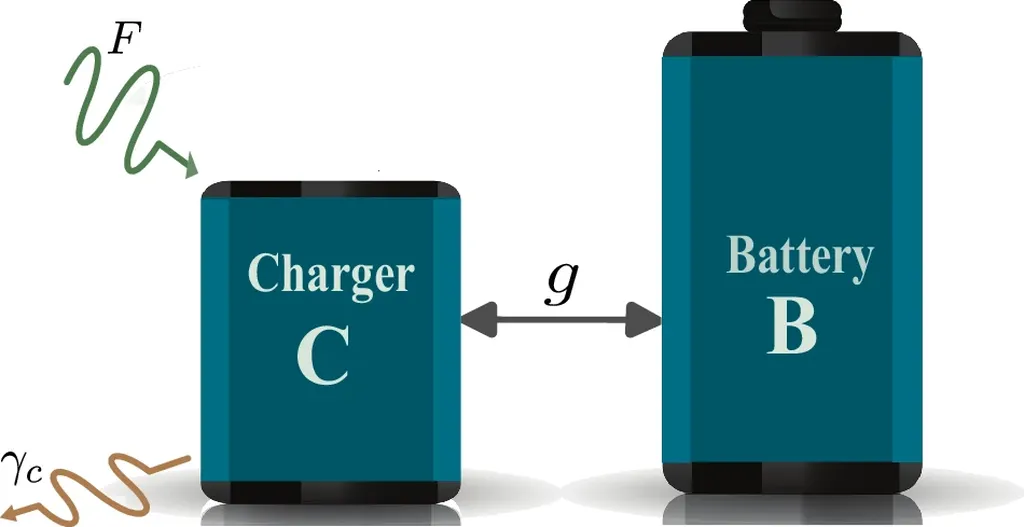
In the realm of quantum technologies, researchers Rohit Kumar Shukla, Sunil K. Mishra, and Ujjwal Sen from the Harish-Chandra Research Institute in India are delving into the intricacies of quantum batteries. Their recent study, published in the journal Physical Review Letters, aims to understand the physical mechanisms behind the enhanced performance of these batteries, which could have significant implications for the energy sector.
Quantum batteries leverage the principles of quantum mechanics to store and charge energy more efficiently than classical batteries. The researchers investigated whether the improved performance stems from genuine quantum correlations, such as entanglement, or from collective dynamics that are not inherently quantum. They analyzed the time evolution of energetic quantities and compared them with various information-theoretic measures that probe different types of correlations.
The study revealed a consistent pattern: the peak charging power occurs before the buildup of strong quantum correlations. This suggests that the initial enhancement in charging performance is primarily due to coherent transport rather than quantum entanglement. Entanglement and other quantum correlations develop later in the process. This finding is crucial for understanding the practical applications of quantum batteries in the energy industry, as it indicates that the initial charging process can be optimized through coherent dynamics, which are easier to control and maintain than quantum entanglement.
The researchers also examined different charging protocols based on local interactions, both in unconstrained and norm-constrained (fair) settings. They found that increasing the interaction order or the number of participating particles does not automatically lead to higher charging power. Instead, the performance is dictated by how many particles become mutually correlated and contribute to entanglement. Fully collective interactions, where all particles participate coherently, provide a genuine advantage. Partially extended interaction schemes, however, do not guarantee improved charging efficiency because they fail to monotonically increase the number of effectively interacting particles.
The insights from this research could pave the way for more efficient and practical quantum batteries. By focusing on coherent dynamics rather than complex quantum correlations, engineers could design batteries that are easier to implement and scale up. This could lead to advancements in energy storage technologies, making quantum batteries a viable option for renewable energy systems and other applications in the energy sector.
The research was published in Physical Review Letters, a prestigious journal in the field of physics, highlighting the significance of the findings in the scientific community. As the understanding of quantum batteries continues to evolve, the energy industry can look forward to innovative solutions that harness the power of quantum mechanics for more efficient and sustainable energy storage.
This article is based on research available at arXiv.