
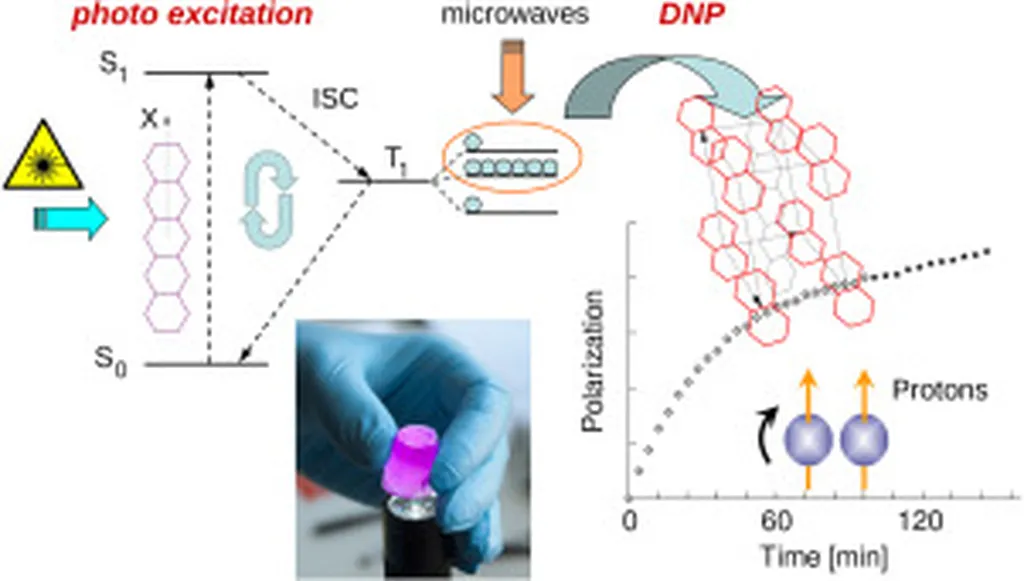
In the world of energy research, advancements in nuclear magnetic resonance (NMR) technology can have significant implications for various applications, including energy storage and materials science. A recent study published in the Journal of Magnetic Resonance by researchers Lorenzo Niccoli, Gian-Marco Camenisch, Matías Chávez, and Matthias Ernst from the Institute for Biomedical Engineering at ETH Zurich and the National University of Singapore, explores a method to enhance the sensitivity of NMR signals through a technique called dynamic nuclear polarization (DNP).
Dynamic nuclear polarization is a method that boosts the intensity of NMR signals by transferring polarization from electron spins to nuclear spins using microwave irradiation. This enhancement is particularly useful in the energy sector for studying the structure and dynamics of materials used in energy storage devices, such as batteries and fuel cells. Pulsed DNP methods offer more precise control over spin dynamics compared to conventional continuous-wave approaches.
The researchers utilized a mathematical framework known as continuous Floquet theory to optimize pulsed DNP sequences. This theory helps in understanding the periodic systems, which is crucial for designing effective DNP sequences. By applying this framework, the team developed both on-resonance and off-resonance DNP sequences. On-resonance sequences are those where the microwave frequency matches the electron spin resonance frequency, while off-resonance sequences involve a slight detuning from this frequency.
Experiments conducted at 80 K and 0.35 T using a sample of 5 mM Trityl OX063 in a glycerol-d8/D2O/H2O matrix demonstrated the effectiveness of these optimized sequences. The on-resonance sequence achieved a remarkable electron offset bandwidth of 100 MHz, while the off-resonance sequence, centered at an electron offset of 50 MHz, covered a bandwidth of 20 MHz. These achievements were realized with microwave power levels of 25 MHz and 20 MHz, respectively.
The practical applications of this research in the energy sector are promising. Enhanced NMR sensitivity can lead to more accurate and detailed studies of materials used in energy storage and conversion technologies. This can accelerate the development of more efficient and durable energy storage solutions, such as advanced batteries and supercapacitors. Additionally, the improved understanding of spin dynamics can contribute to the development of new materials with tailored properties for energy applications.
In summary, the study by Niccoli and colleagues presents a significant advancement in the optimization of pulsed DNP sequences using continuous Floquet theory. This research not only enhances the sensitivity of NMR signals but also opens up new possibilities for studying and developing materials crucial for the energy sector. The findings were published in the Journal of Magnetic Resonance, providing a valuable resource for researchers and industry professionals working on energy-related applications.
This article is based on research available at arXiv.