
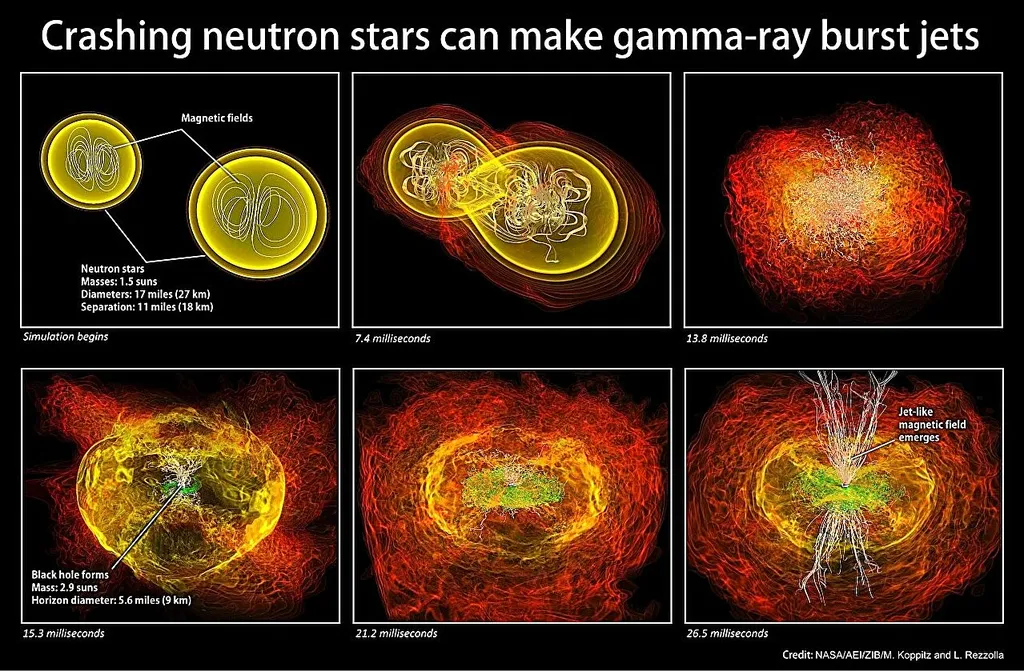
In the realm of astrophysics and energy research, a team of scientists from various institutions, including the University of New Hampshire, the University of California, Berkeley, and the University of Notre Dame, has been delving into the complex behavior of neutrinos in extreme environments. Their work, recently published in the journal Physical Review D, focuses on understanding neutrino flavor instabilities in the aftermath of neutron star mergers, a phenomenon that could have significant implications for our understanding of these cataclysmic events and, potentially, for energy production here on Earth.
Neutrinos, often referred to as “ghost particles,” are fundamental particles that play a crucial role in nuclear reactions and energy production. In the dense and hot environments following neutron star mergers, neutrinos can undergo flavor oscillations, where they switch between different types, or “flavors.” These oscillations can significantly impact the dynamics of the merger and the resulting energy output. However, accurately predicting these oscillations has been a longstanding challenge.
The research team employed a sophisticated angular moment-based linear stability analysis framework to investigate the different kinds of flavor instabilities that can occur in these environments. They found that, contrary to what has been observed in other astrophysical contexts like core-collapse supernovae, commonly used approximations for neutrino behavior can provide accurate predictions in the context of neutron star mergers. This finding simplifies the modeling of these complex events.
The team also explored the impact of various physical effects, including nuclear many-body corrections, scattering opacities, and the inclusion of the vacuum term in the neutrino Hamiltonian. They found that these factors can significantly influence the behavior of neutrinos in these environments.
Perhaps most intriguingly, the researchers were able to explore, for the first time in a multi-energy setting, the interplay between different types of neutrino flavor instabilities—collisional, fast, and slow modes—in a moment-based neutron star merger simulation. They found that while the fast instability tends to dominate in most of the simulation volume, certain regions exhibit only a collisional instability, and others, particularly at large distances, exhibit a slow instability that is largely underestimated if anisotropic effects are neglected.
The practical applications of this research for the energy sector are still largely theoretical. However, a deeper understanding of neutrino behavior in extreme environments could potentially inform the development of advanced energy technologies, such as fusion reactors, which rely on similar nuclear processes. Moreover, the methods and insights gained from this research could contribute to our broader understanding of nuclear physics and energy production.
This research was published in Physical Review D, a peer-reviewed journal dedicated to publishing fundamental research in all areas of theoretical and experimental particle physics.
This article is based on research available at arXiv.