
In the realm of energy and materials science, a team of researchers from various institutions, including the Indian Institute of Science, the National University of Singapore, and the National Institute for Materials Science in Japan, has made a significant discovery that could have implications for the future of optoelectronics and energy technologies. Their work focuses on the dynamic interplay between excitonic and phononic quasiparticles in moiré superlattices, a topic that has been relatively underexplored until now.
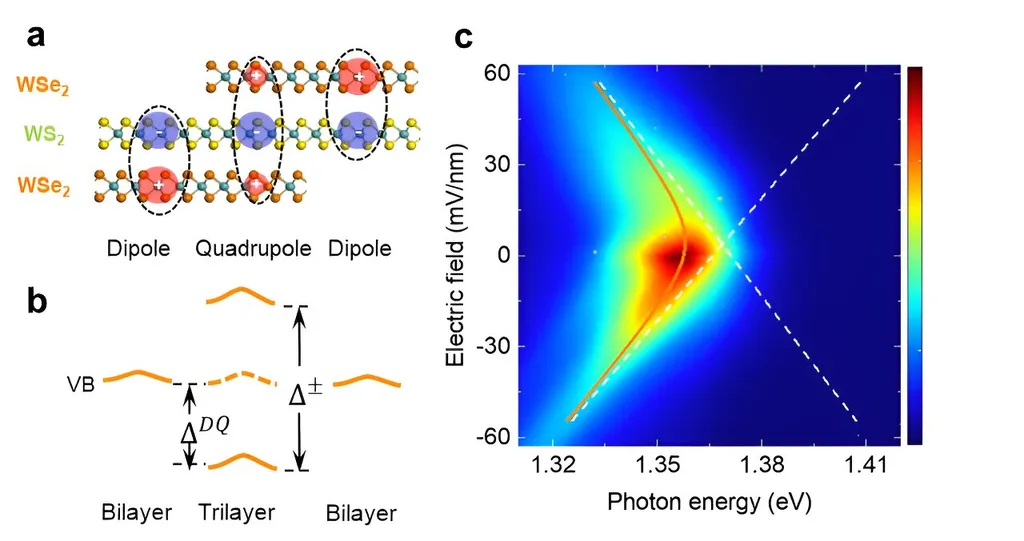
The researchers, led by Ranju Dalal, Harsimran Singh, and Akshay Singh, have been investigating the interactions among electronic and lattice degrees-of-freedom in WSe2/WS2 heterostructures. These heterostructures are made by combining two different semiconductor materials, tungsten diselenide (WSe2) and tungsten disulfide (WS2), in a way that creates a moiré pattern—a kind of interference pattern that can trap and manipulate excitons, which are pairs of electrons and holes that can carry energy.
In their study, the researchers found that by optically suppressing ultrafast charge-transfer to interlayer excitons, they could reveal the dynamics of moiré intralayer excitons (IALX). These IALXs have remarkably long lifetimes, lasting more than 1000 picoseconds. This longevity is due to the localized Wannier and in-plane charge-transfer nature of these excitons. The team also observed moiré intralayer intervalley biexcitons, which are pairs of excitons bound together, with a binding energy of around 16 meV. These biexcitons also have long lifetimes due to the confinement provided by the moiré pattern.
Perhaps most intriguingly, the researchers found evidence of strong coupling between the moiré IALXs and ultralow-energy collective lattice modes, known as phasons. This coupling was evidenced by twist-angle-dependent GHz oscillations in the IALX dynamics. The twist angle refers to the angle at which the two semiconductor materials are stacked, which can significantly affect the properties of the resulting heterostructure.
The findings of this study, published in the journal Nature Communications, establish moiré superlattices as interacting hybrid quantum systems with potential applications in engineering non-equilibrium phenomena. Moreover, they suggest that these systems could be harnessed for GHz-scale optoelectronics, which could have significant implications for the energy sector. Optoelectronics is a field that combines optics and electronics, and it has the potential to revolutionize the way we generate, transmit, and use energy. For instance, more efficient solar cells, advanced sensors, and high-speed data transmission systems could all be made possible by advances in optoelectronics. This research brings us one step closer to realizing these possibilities.
In summary, this research highlights the potential of moiré superlattices in the field of optoelectronics and energy technologies. By manipulating the interactions between excitons and phonons, researchers may be able to develop new materials and devices that are more efficient, faster, and more versatile than those currently available. As such, this work represents an exciting step forward in the ongoing quest to harness the power of quantum mechanics for practical applications.
This article is based on research available at arXiv.