
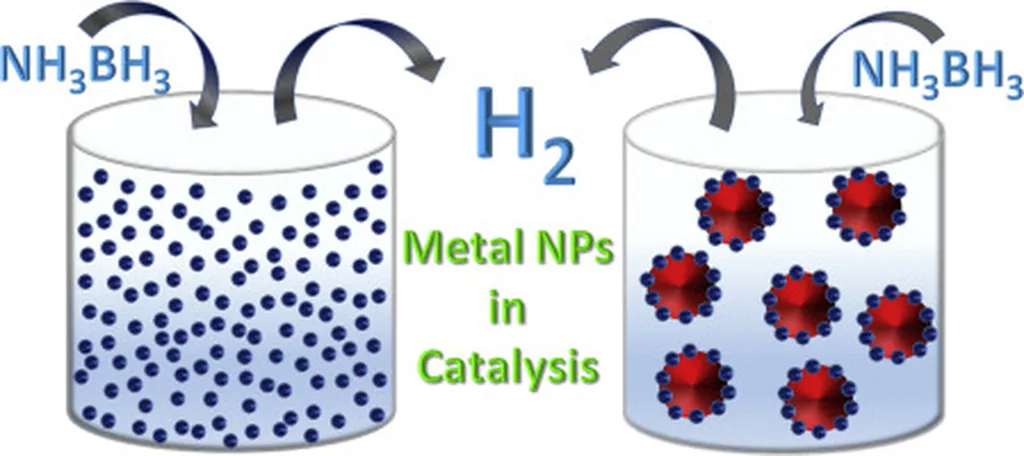
Researchers from Michigan State University, led by Marcos Dantus, have uncovered new insights into the ultrafast fragmentation dynamics of ammonia borane (AB), a promising hydrogen storage material. The team, including Sung Kwon, Naga Krishnakanth Katturi, Bruno I. Moreno, and Carlos Cárdenas, utilized femtosecond time-resolved strong-field ionization techniques to study the behavior of AB following single and double ionization. Their findings, published in the Journal of Physical Chemistry Letters, offer valuable information for the energy sector, particularly in the development of hydrogen storage technologies.
Ammonia borane is known for its high hydrogen content, making it an attractive candidate for hydrogen storage applications. However, understanding its fragmentation dynamics is crucial for optimizing its use in energy storage and release. The researchers employed mass spectrometry and advanced computational methods to identify the molecular origins of neutral and ionic products resulting from AB’s ionization.
Upon single ionization, AB releases neutral hydrogen atoms (H) and molecules (H2). When doubly ionized, AB produces additional ionic species, including H+, H2+, and H3+, all within one picosecond. The team’s electronic-structure calculations revealed that these hydrogen-containing products primarily originate from the hydrogen atoms bound to the boron center in AB. The formation of these species involves hydrogen migration and, in some cases, a process called neutral H2 roaming.
Interestingly, the study found that the dication (doubly ionized AB) has the potential to release neutral H2, a prerequisite for forming the astrochemically relevant H3+ ion. However, the large adiabatic relaxation energy causes most of the roaming H2 to dissociate before it can abstract a proton, thereby suppressing H3+ formation. This insight is particularly relevant for the energy sector, as it provides a deeper understanding of the hydrogen-release mechanisms in ammonia-borane-based storage materials.
The researchers’ findings extend mechanistic principles developed for halogenated alkanes to ammonia borane, offering a broader perspective on the dissociation pathways in hydrogen-rich molecules. This knowledge can be instrumental in designing more efficient hydrogen storage systems and improving the overall performance of ammonia borane as an energy carrier. The study highlights the importance of ultrafast dynamics in the fragmentation of hydrogen-rich materials, paving the way for further advancements in hydrogen storage technologies.
This article is based on research available at arXiv.