
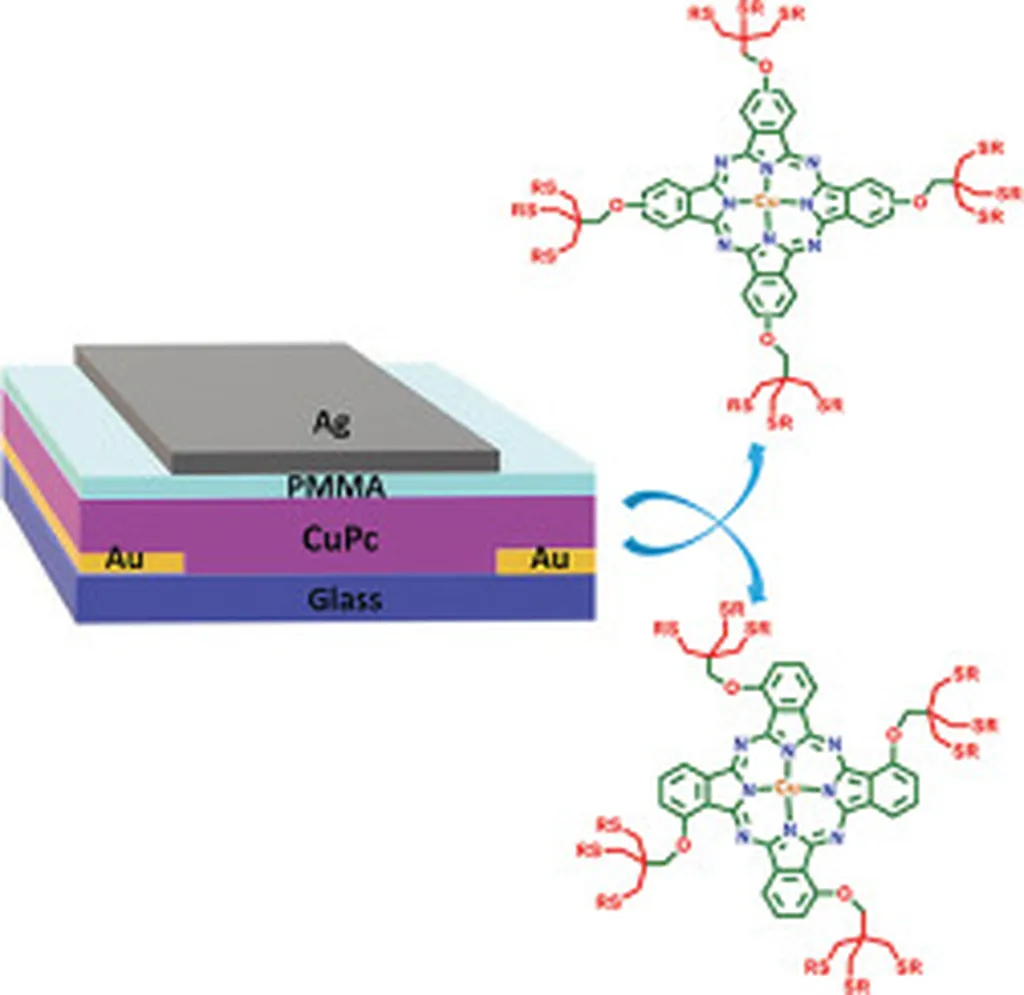
Researchers from the University of Strasbourg, including L. B. Avila, Zuchong Yang, and their colleagues, have published a study in the journal Advanced Electronic Materials that explores the charge transport properties of liquid-crystalline phthalocyanines in thin-film transistors. Phthalocyanines are a class of organic compounds that have potential applications in organic electronics, including organic photovoltaics and organic thin-film transistors (OTFTs).
The researchers investigated a series of liquid-crystalline phthalocyanines, both metal-free and complexes with copper, zinc, nickel, and cobalt. They used Raman spectroscopy to study the vibrational signatures of these compounds and correlated them with their electronic performance in OTFTs. The study revealed that the metal coordination in phthalocyanines induces distortions in the phthalocyanine macrocycle, which are reflected in systematic shifts of the C-N-C and M-N vibrational modes.
When integrated into OTFTs, all compounds exhibited significantly enhanced current response under ultrahigh vacuum compared to an N2-rich environment. This demonstrates that intrinsic charge transport in these materials is strongly suppressed by atmospheric species. The researchers suggest that this suppression is likely due to the presence of water or oxygen in the atmosphere, which can act as electron traps and reduce the mobility of charge carriers.
Temperature-dependent measurements were also conducted, ranging from 100 to 300 K. These measurements revealed clear threshold-voltage shifts driven by deep interface and bulk traps. Despite these traps, all devices displayed thermally activated mobility with low activation energies, ranging from 14 to 20 meV. This indicates that the charge transport in these materials is not significantly hindered by thermal fluctuations.
The researchers highlight that mesomorphic order, metal coordination, and environmental conditions collectively govern charge transport in liquid-crystalline phthalocyanines. These findings offer design guidelines for the use of these materials as orientable semiconducting materials in organic electronics. The practical applications of this research could include the development of more efficient and stable organic solar cells and OTFTs, which are important for the energy industry’s transition towards renewable and flexible electronics.
In summary, this study provides valuable insights into the factors that influence charge transport in liquid-crystalline phthalocyanines. By understanding and controlling these factors, researchers can design and develop more efficient organic electronic devices, contributing to the advancement of renewable energy technologies.
This article is based on research available at arXiv.