
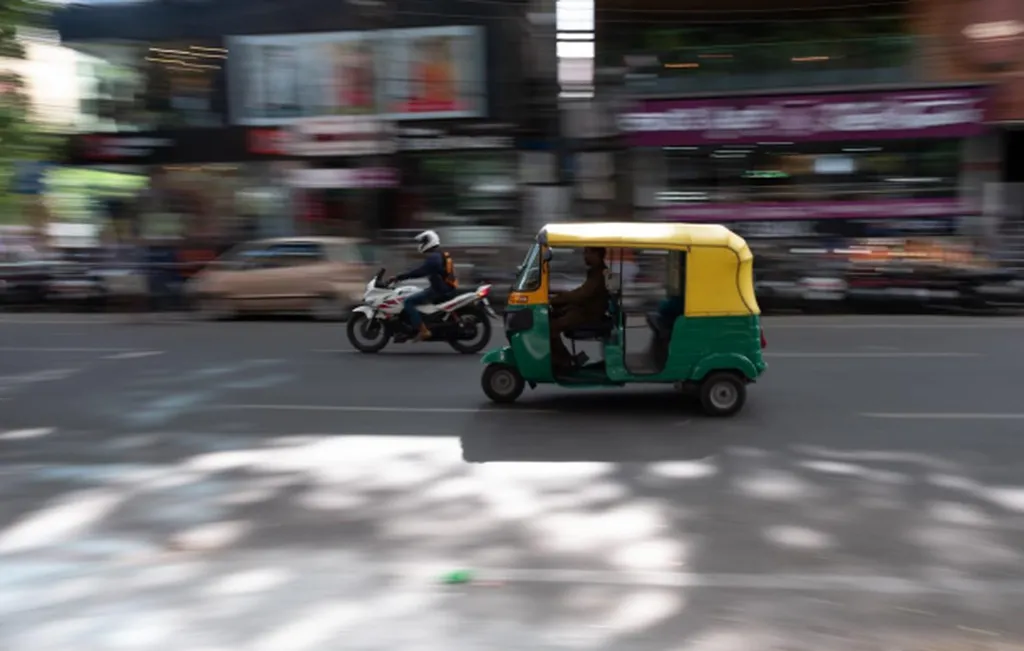
In the realm of intelligent transportation systems, a team of researchers from the Indian Institute of Technology, Bombay, led by Sumit S. Shevtekar, has made significant strides in understanding and predicting the time pressure experienced by powered two-wheeler riders. Their work, published in the journal IEEE Transactions on Intelligent Transportation Systems, aims to enhance safety measures for riders by proactively intervening in high-risk situations.
The study presents a comprehensive dataset comprising over 129,000 labeled multivariate time-series sequences from 153 rides by 51 participants. These sequences capture a wide array of features, including vehicle kinematics, control inputs, behavioral violations, and environmental context. The researchers found that high time pressure leads to more risky behaviors, such as increased speeds, greater speed variability, more risky turns at intersections, sudden braking, and higher rear brake forces compared to no time pressure.
To leverage this dataset, the team developed MotoTimePressure, a deep learning model that combines convolutional preprocessing, dual-stage temporal attention, and Squeeze-and-Excitation feature recalibration. This model achieved an impressive accuracy of 91.53% and a ROC AUC of 98.93%, outperforming eight baseline models. The significance of this model lies in its ability to predict time pressure, which cannot be directly measured in real time, thereby enabling proactive safety interventions.
The researchers demonstrated the utility of their model in collision prediction and threshold determination. By using the predicted time pressure as features, they improved the accuracy of an Informer-based collision risk prediction model from 91.25% to 93.51%, approaching oracle performance. This improvement highlights the potential of the MotoTimePressure model to enhance the safety of powered two-wheeler riders.
Practical applications for the energy sector include the development of intelligent transportation systems that can monitor and predict the time pressure of riders. This information can be used to implement proactive safety measures, such as adaptive alerts, haptic feedback, V2I (Vehicle-to-Infrastructure) signaling, and speed guidance. These interventions support safer two-wheeler mobility under the Safe System Approach, ultimately reducing the risk of accidents and improving overall road safety.
In summary, the research conducted by Sumit S. Shevtekar and his team at the Indian Institute of Technology, Bombay, provides valuable insights into the prediction of time pressure among powered two-wheeler riders. Their deep learning model, MotoTimePressure, offers a promising tool for enhancing safety measures in intelligent transportation systems, with significant implications for the energy sector. The study was published in the IEEE Transactions on Intelligent Transportation Systems.
This article is based on research available at arXiv.