
Researchers Chunhui Zhao, Xirui Kao, Yilin Lu, and Yang Lyu from the University of Pennsylvania have developed a new framework for improving the landing capabilities of quadcopters, which could have significant implications for the energy sector, particularly in areas like drone-based inspections and maintenance of energy infrastructure. The research was published in the journal IEEE Transactions on Robotics.
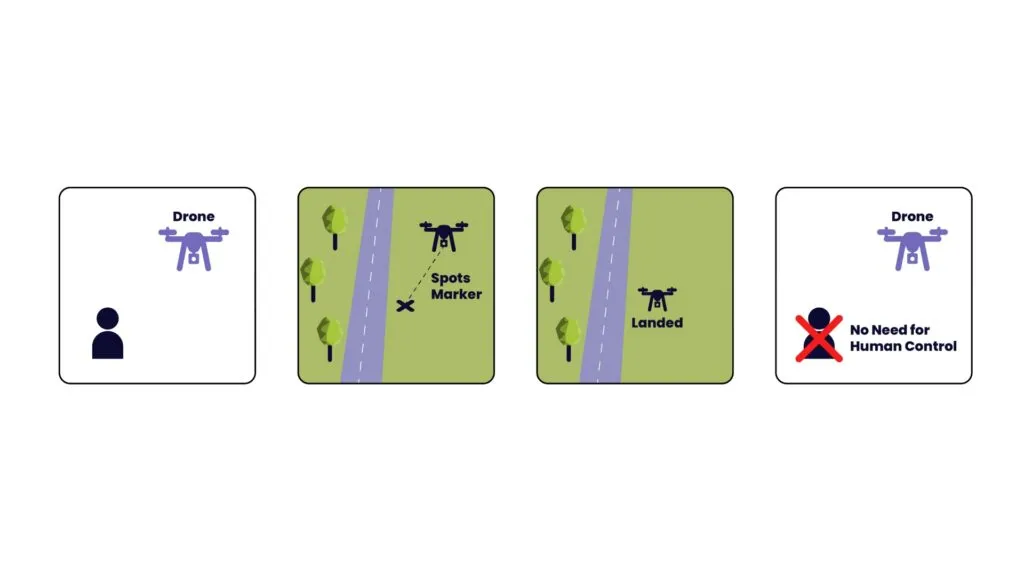
The team’s work addresses a key challenge in autonomous drone operations: landing on moving platforms. Traditional methods often struggle in highly dynamic scenarios because they treat the landing platform as a passive target, forcing the drone to perform complex, sequential maneuvers. The researchers propose a bi-directional cooperative landing framework that redefines the roles of the drone and the platform. Instead of the drone doing all the work to align and descend, the platform becomes an active participant in the landing process.
The innovation lies in transforming the problem from a single-agent tracking challenge into a coupled system optimization. The mobile platform proactively adjusts its surface to create an optimal and stable landing attitude for the approaching drone. This active cooperation allows the alignment and descent phases to happen concurrently, rather than sequentially. Meanwhile, the drone focuses on generating a time-optimal and energy-efficient trajectory. This bi-directional coordination enables the system to execute landings more efficiently, precisely, and robustly, even in complex and time-constrained missions.
For the energy industry, this technology could enhance the capabilities of drones used for inspecting and maintaining critical infrastructure such as power lines, wind turbines, and pipelines. By enabling more agile and reliable landings on moving platforms, these drones could operate more flexibly and efficiently, reducing downtime and improving safety. The framework’s ability to minimize energy consumption during landing could also extend the operational range and duration of drone missions, further enhancing their utility in the energy sector.
This article is based on research available at arXiv.