
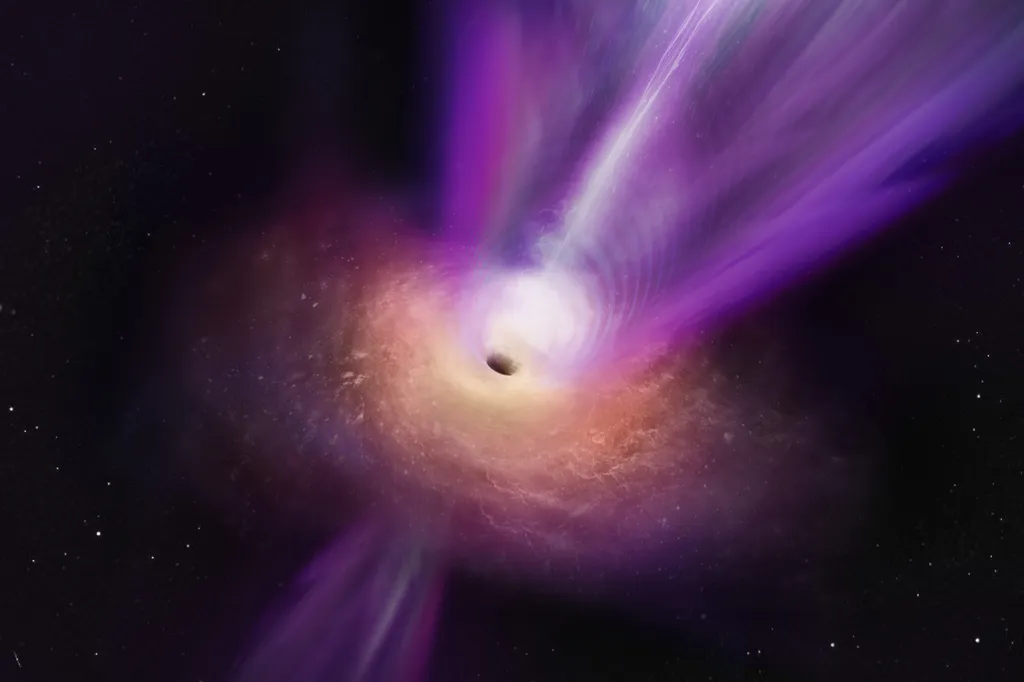
In the realm of astrophysics, a team of researchers led by Noa Grollimund from the University of Oxford, along with colleagues from various institutions including the University of Paris and the University of Cape Town, has made a significant discovery related to black hole transients. Their findings, published in the journal Nature Astronomy, shed new light on the behavior of black holes and their potential role in the production of cosmic rays.
The team focused their investigation on V4641 Sgr, a black hole transient known for its powerful, superluminal radio jets. These jets, which can travel several parsecs from the black hole, interact with the interstellar medium and have been suggested to play a crucial role in the production of galactic cosmic rays. However, until now, no large-scale radio counterpart of these jets had been observed.
Using the MeerKAT radio telescope, the researchers conducted deep observations of V4641 Sgr at the L and UHF bands. They discovered a large-scale, bow-tie-shaped, diffuse radio structure around the black hole, spanning approximately 35 parsecs. This structure is similar in size to the extended X-ray emission previously discovered by the XRISM satellite, but it does not coincide spatially with the extended very-high-energy (VHE) gamma-ray emission.
The researchers suggest that this bow-tie structure is likely the result of long-term action of large-scale jets or disk winds from V4641 Sgr. If the emission mechanism is of synchrotron origin, the radio/X-ray extended structure implies the acceleration of electrons up to more than 100 TeV as far as tens of parsecs from the black hole.
While this research may seem far removed from the energy industry, understanding the behavior of black holes and their jets can have significant implications. For instance, the study of cosmic rays, which are produced by these jets, can help us better understand the radiation environment in space and its potential impact on space-based solar power systems. Additionally, the acceleration mechanisms at play in these astrophysical phenomena could inspire new approaches to particle acceleration in fusion energy research.
In conclusion, this discovery by Grollimund and her team provides valuable insights into the behavior of black holes and their jets, contributing to our understanding of cosmic rays and their origins. As we continue to explore the universe, these findings may also pave the way for innovative applications in the energy sector.
This article is based on research available at arXiv.