
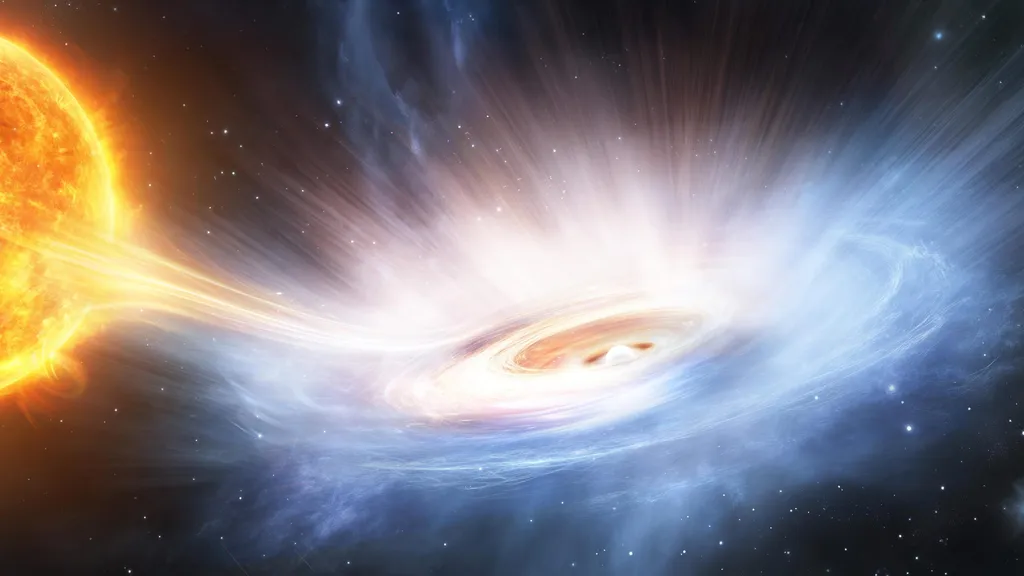
In the realm of energy and astrophysics, a team of researchers led by Noel Castro Segura from the University of Southampton, along with collaborators from various institutions including Virginia Cúneo from the University of Cambridge and Francesco Tombesi from the University of Rome, are delving into the mysteries of accreting systems and their disc winds. These systems, which include accreting white dwarfs, X-ray binaries, and active galactic nuclei, play a crucial role in regulating both the accretion flow and the surrounding environment.
The team’s research, published in the journal Nature Astronomy, focuses on the temporal evolution of disc winds in these accreting systems. Disc winds are outflows that originate from the accretion discs around these celestial objects. By studying these winds, researchers aim to understand the accretion process and its feedback mechanisms, which have implications for binary evolution, wind feedback, and a unified view of accreting systems across different mass scales.
Current understanding indicates that disc winds can evolve rapidly, sometimes within minutes, and play a significant role in regulating the accretion flow. However, progress in this field has been hindered by the transient nature of these winds, sparse time coverage, and the lack of simultaneous, high-resolution spectroscopy. The researchers emphasize the need for advanced time-domain facilities that can provide high temporal and spectral resolution to track these events in high accretion-rate systems.
The practical applications of this research for the energy sector are indirect but significant. Understanding the accretion process and feedback mechanisms can provide insights into the fundamental physics of energy transfer and conversion. This knowledge can be applied to improve energy technologies, such as fusion energy, where understanding plasma behavior and energy transfer is crucial. Additionally, the study of disc winds and their impact on the surrounding environment can inform our understanding of space weather and its potential effects on space-based energy infrastructure.
In summary, the research led by Noel Castro Segura and his team sheds light on the complex interplay between accretion and disc winds in various astrophysical systems. While the direct applications to the energy sector may be indirect, the fundamental understanding gained from this research can contribute to advancements in energy technologies and our comprehension of space weather. The team’s work highlights the importance of continued investment in high-resolution observational facilities to unravel the mysteries of these dynamic and influential astrophysical phenomena.
This article is based on research available at arXiv.