
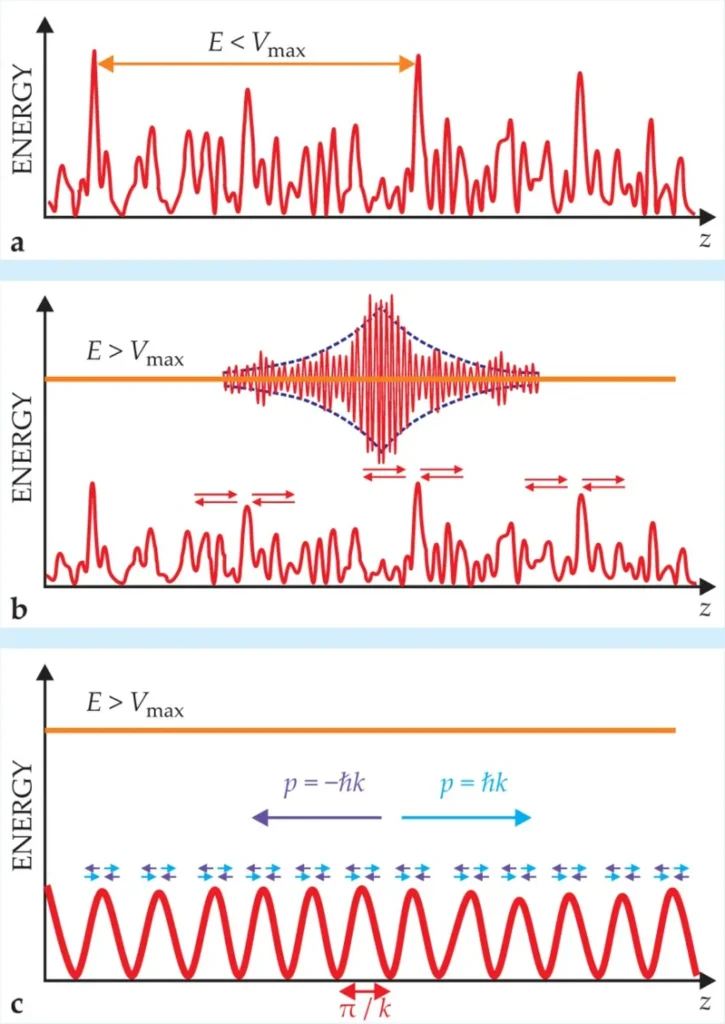
Researcher Jake S. Bobowski from the University of California, San Diego has delved into the intriguing phenomenon of Anderson localization, which describes how wave diffusion can be suppressed in disordered media due to multiple scattering interference. In a recent study, Bobowski presented two complementary simulations that explore this concept, offering valuable insights for the energy sector.
The first simulation models the random walk of classical, non-interacting point-like particles. This provides a clear analogy to how disorder can limit transport, a concept that can be applied to understanding energy transport in disordered systems, such as certain types of solar cells or thermal insulation materials. By observing how particles move in a disordered environment, researchers can gain insights into how energy might be similarly transported and potentially hindered.
The second simulation examines the propagation of an electromagnetic pulse through a one-dimensional, lossless transmission line with randomly varying propagation constant and characteristic impedance. This system captures the interference effects essential for true Anderson localization. In the context of the energy industry, this could have implications for the design and optimization of power transmission lines, particularly in areas with varying environmental conditions that can introduce disorder into the system.
Bobowski evaluated quantitative measures that reveal the transition from normal diffusion to localization of particles in one case, and the exponential confinement of wave energy in the other. These findings could help energy researchers develop more efficient and reliable systems for energy transport and storage.
The research was published in the American Journal of Physics, providing a pair of accessible tools for investigating localization phenomena in an instructional setting. By understanding and applying these principles, the energy industry can potentially improve the performance and reliability of various systems, from solar cells to power transmission lines.
This article is based on research available at arXiv.