
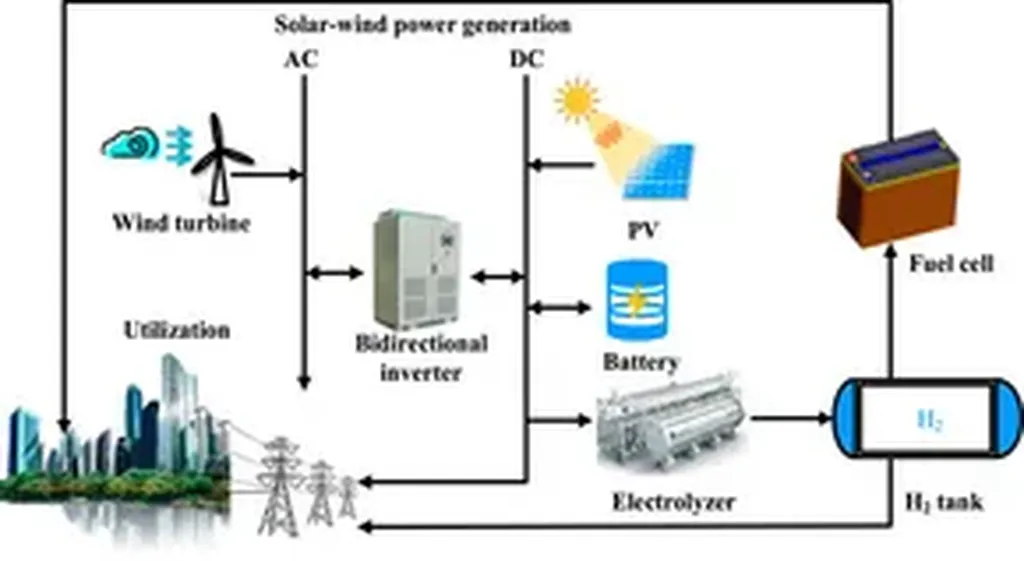
Researchers from the School of Electrical and Information Engineering at Tianjin University in China, led by Pengfeng Lin and Guangjie Gao, have developed a novel control strategy for a hybrid hydrogen electrolyzer-supercapacitor system (HESS) designed to support renewable-dominant power grids. The team, which includes Jianjun Ma, Miao Zhu, Xinan Zhang, and Ahmed Abu-Siada, presented their findings in a paper published in the IEEE Transactions on Industrial Electronics.
The proposed HESS combines alkaline electrolyzers (AEL), proton exchange membrane electrolyzers (PEMEL), and supercapacitors (SC) to manage power fluctuations in renewable energy systems. The key innovation lies in the control strategy, which assigns different power management roles to each component based on their characteristics. Supercapacitors handle high-frequency transient power, PEMEL manages stable frequency power, and AEL addresses low-frequency steady-state power. This division allows the system to respond autonomously to grid frequency changes without requiring additional communication infrastructure.
One of the significant advantages of this system is the extended lifespan of the supercapacitors. By implementing a state of charge (SOC) recovery control, the supercapacitors can endure more than three times the number of stability discharge cycles compared to those without SOC recovery. This enhancement is crucial for the long-term reliability and cost-effectiveness of the system.
The researchers also developed a large-signal mathematical model based on mixed potential theory to provide clear stability boundaries for system parameters. This model helps ensure the system’s feasibility and reliability under various operating conditions. The team validated their approach through dynamic analyses and extensive hardware-in-the-loop experimental results, confirming the effectiveness of the proposed HESS and its transient power allocation controls.
For the energy industry, this research offers a practical solution for integrating renewable energy sources into the grid by providing a robust and efficient means of managing power fluctuations. The HESS can help stabilize grid frequency, reduce energy losses, and extend the lifespan of critical components, making it a valuable tool for enhancing the reliability and sustainability of renewable-dominant power systems.
This article is based on research available at arXiv.