
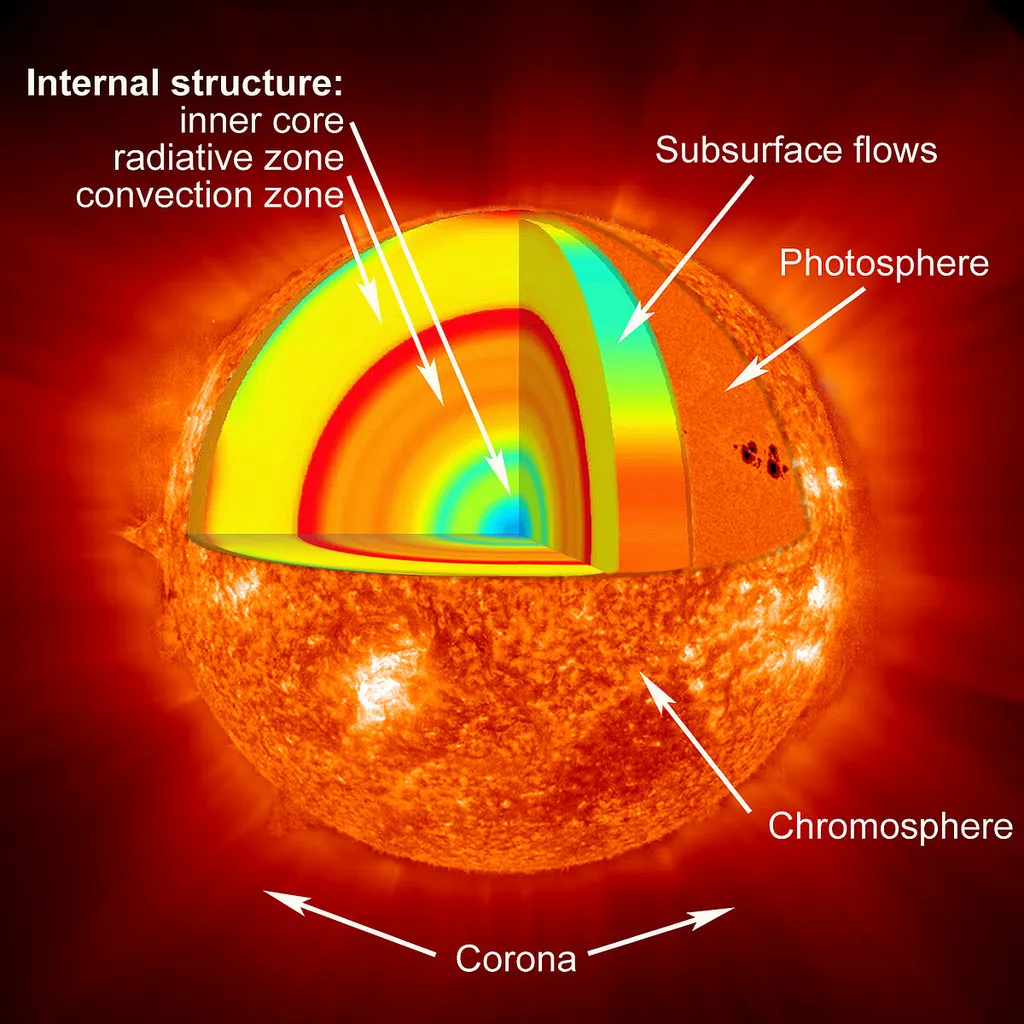
In the realm of solar physics, understanding the mechanisms behind chromospheric heating is crucial for comprehending the energy dynamics of the solar atmosphere. This intricate process has been the focus of recent research by Elias R. Udnæs and Tiago M. D. Pereira, both affiliated with the Rosseland Centre for Solar Physics at the University of Oslo, Norway.
The researchers employed advanced 3D radiative magnetohydrodynamic simulations of the solar atmosphere, coupled with non-LTE spectral synthesis, to estimate chromospheric heating from synthetic spectra. Their study, published in the Astrophysical Journal, delves into the spectral and temporal signatures of heating events, providing valuable insights into the energy budget of the solar chromosphere.
By analyzing the Mg II h, Ca II H, and Ca II 8542 Å lines, Udnæs and Pereira utilized k-means clustering to identify representative profiles associated with elevated chromospheric heating. Their findings reveal that locations with the strongest chromospheric heating exhibit spectral signatures characterized by strong emission. Notably, they identified two distinct types of profiles: blue grains, which show strong emission in the blue wing of the lines, and red grains, which display strong emission in the red wing.
Blue grains are generated by upward-propagating shock waves and exhibit an order of magnitude higher heating in the chromosphere compared to the ambient heating. These profiles also demonstrate a consistent temporal evolution, characterized by an oscillating sawtooth pattern in the line core and emission in the blue wing. In contrast, red grains, while also displaying significantly stronger heating than the baseline, do not exhibit a characteristic atmospheric stratification. Moreover, red grains do not show a consistent temporal signature, as red wing emission can appear spontaneously or be associated with an oscillation.
Despite accounting for only around 3% of the synthetic spectra, blue and red grain profiles collectively contribute to more than 12% of the total chromospheric heating in the simulations. The researchers also compared two quiet Sun simulations and found that the prevalence of bright grains is influenced by the magnetic field configuration. A unipolar configuration was observed to have fewer bright grains, resulting in a lower share of heating from such events.
The practical applications of this research for the energy sector are manifold. A deeper understanding of chromospheric heating mechanisms can enhance our ability to predict and mitigate the impacts of solar activity on Earth’s energy infrastructure. This includes protecting satellites, power grids, and communication systems from solar storms and other space weather phenomena. Additionally, insights into solar energy dynamics can inform the development of solar energy technologies, such as solar panels and concentrators, by optimizing their design and efficiency based on a better understanding of solar radiation.
In conclusion, the work of Udnæs and Pereira sheds light on the complex processes governing chromospheric heating, offering valuable insights for both solar physics and the energy industry. Their findings contribute to our broader understanding of solar energy dynamics and their implications for technological applications on Earth.
This article is based on research available at arXiv.