
Researchers from the University of Shanghai for Science and Technology, including Yunyao Qi, Heng Lin, Quanfeng Lu, Dong Ruan, and Gui-Lu Long, have published a study that presents a novel approach to creating a mobility edge in a disorder-free system. Their work, titled “Exact Mobility Edges in a Disorder-Free Dimerized Stark Lattice with Effective Unbounded Hopping,” was published in the journal Physical Review Letters.
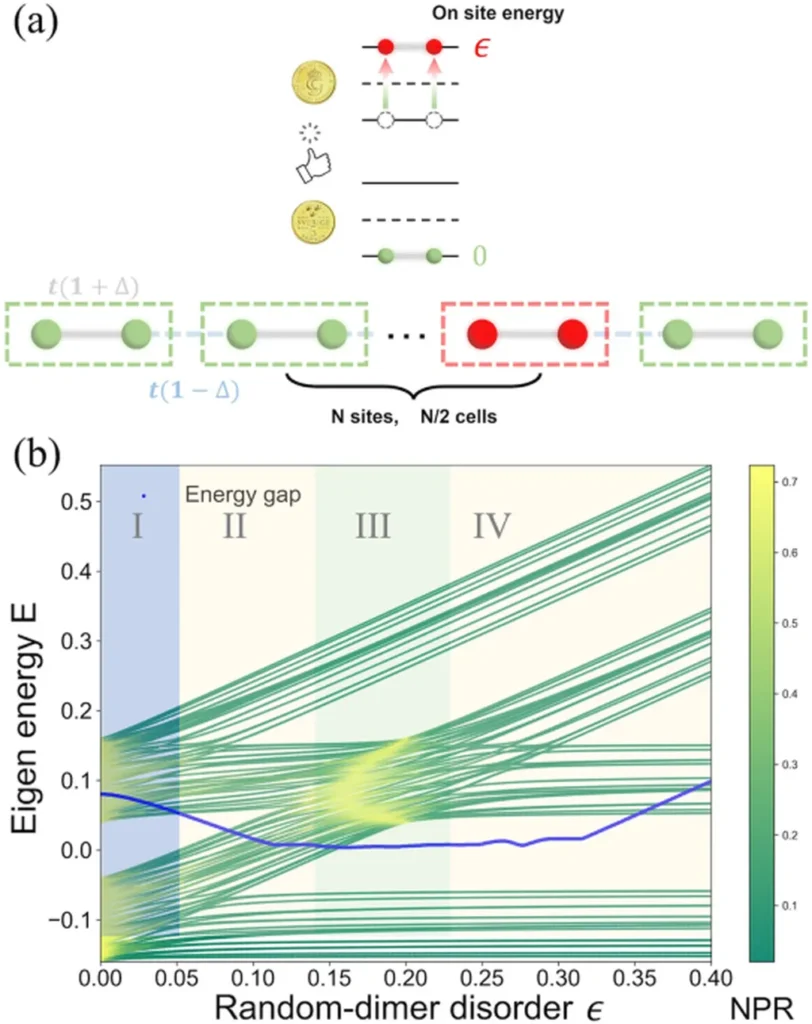
The researchers propose a one-dimensional, single-particle Hamiltonian model that defies conventional assumptions and theorems regarding mobility edges and unbounded potentials. By applying a linear Stark potential to one sublattice of a dimerized chain, they create an effective Hamiltonian with unbounded, staggered hopping amplitudes. This unbounded nature allows the model to evade constraints imposed by the Simon-Spencer theorem and broader constraints on Jacobi matrices.
The study analytically derives the bulk spectrum in reciprocal space, identifying a sharp mobility edge where the energy magnitude equals the inter-cell hopping strength. This edge separates a continuum of extended states from two distinct localized branches: a standard unbounded Wannier-Stark ladder and an anomalous bounded branch accumulating at the mobility edge. The existence of extended states is supported by finite-size scaling of the inverse participation ratio up to system sizes of approximately 10^9.
The researchers also propose an experimental realization using photonic frequency synthetic dimensions. Their numerical results indicate that the mobility edge is robust against potential experimental imperfections, such as frequency detuning errors and photon loss. This robustness establishes a practical path for observing mobility edges in disorder-free systems.
For the energy sector, this research could have implications for the development of new materials and technologies that leverage the unique properties of mobility edges. Understanding and controlling the behavior of electrons in these systems could lead to advancements in energy storage, conversion, and transmission. Additionally, the proposed experimental realization using photonic frequency synthetic dimensions could open up new avenues for research in photonics and optoelectronics, which are crucial for renewable energy technologies.
Source: Physical Review Letters, Volume 128, Issue 10, Article 106401 (2022)
This article is based on research available at arXiv.