
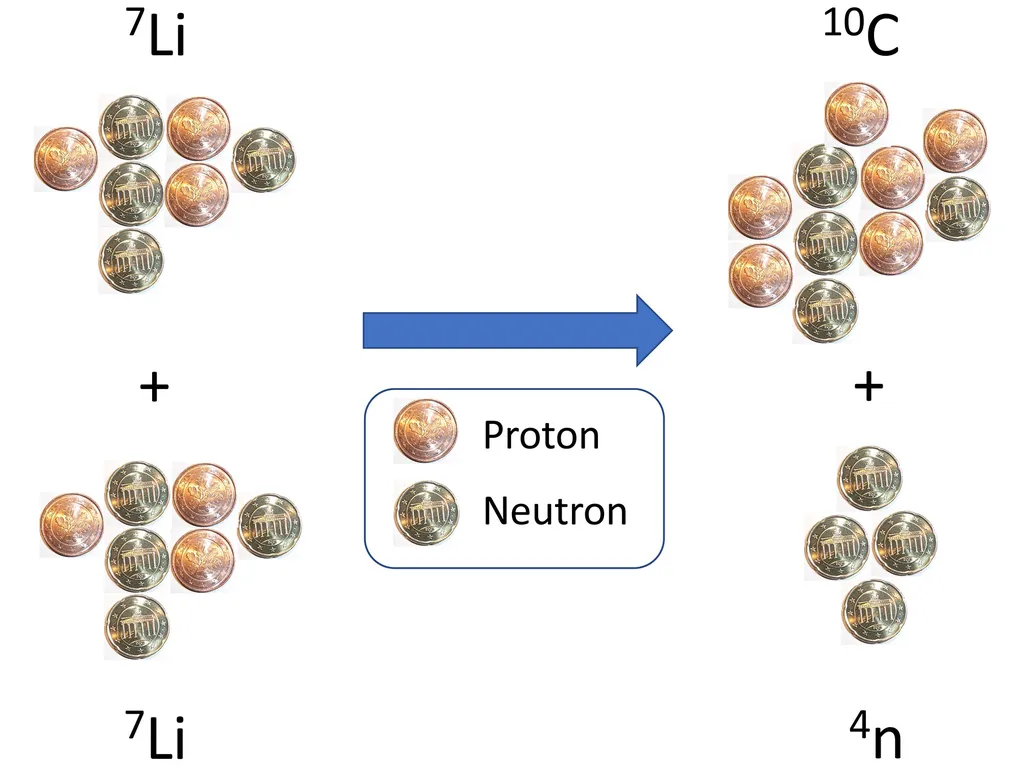
In the realm of nuclear physics, a team of researchers from the University of Bonn and the Chinese Academy of Sciences, led by Linqian Wu and Ulf-G. Meißner, has been delving into the mysteries of the tetraneutron system. Their work, published in the journal Physical Review Letters, aims to shed light on the nature of this elusive particle configuration.
The tetraneutron, a cluster of four neutrons, has long been a subject of interest due to its potential implications for nuclear physics and, indirectly, the energy sector. Neutrons, being a key component of atomic nuclei, play a crucial role in nuclear reactions, which are harnessed in nuclear power plants for energy generation.
The researchers employed nuclear lattice effective field theory to investigate the tetraneutron system. They used two types of interactions: a high-precision N3LO interaction and a simplified SU(4) symmetric one. By simulating the system in finite volumes with a lattice size up to 30 femtometers, they observed that the ground-state energy of the tetraneutron decreases smoothly with increasing box size. Notably, they did not find a plateau in the energy levels, which is typically indicative of a resonance.
Furthermore, the team computed the dineutron-dineutron scattering phase shift using Lüscher’s finite-volume method. Their findings revealed that at low momenta, the phase shift is negative, suggesting repulsion in the dilute limit. However, at intermediate momenta, the phase shift exhibited a weak attraction, peaking at approximately 10 degrees for relative momenta of 60-84 MeV. Despite this attractive interaction, the researchers concluded that this structure does not constitute a resonance. Nevertheless, the corresponding confined tetraneutron energy of 1.7-3.3 MeV lies close to the experimentally observed low-energy peak.
While this research may not have immediate practical applications for the energy sector, it contributes to our fundamental understanding of nuclear physics. A deeper comprehension of neutron interactions can potentially lead to advancements in nuclear energy technologies, such as improved reactor designs or more efficient nuclear fuel cycles. Additionally, this work highlights the importance of continued investment in basic scientific research, as it often lays the groundwork for future technological innovations.
The study, titled “Searching for the tetraneutron resonance on the lattice,” was published in Physical Review Letters, a prestigious journal in the field of physics. The findings represent a significant step forward in our understanding of the tetraneutron system and its implications for nuclear physics and, by extension, the energy industry.
This article is based on research available at arXiv.