
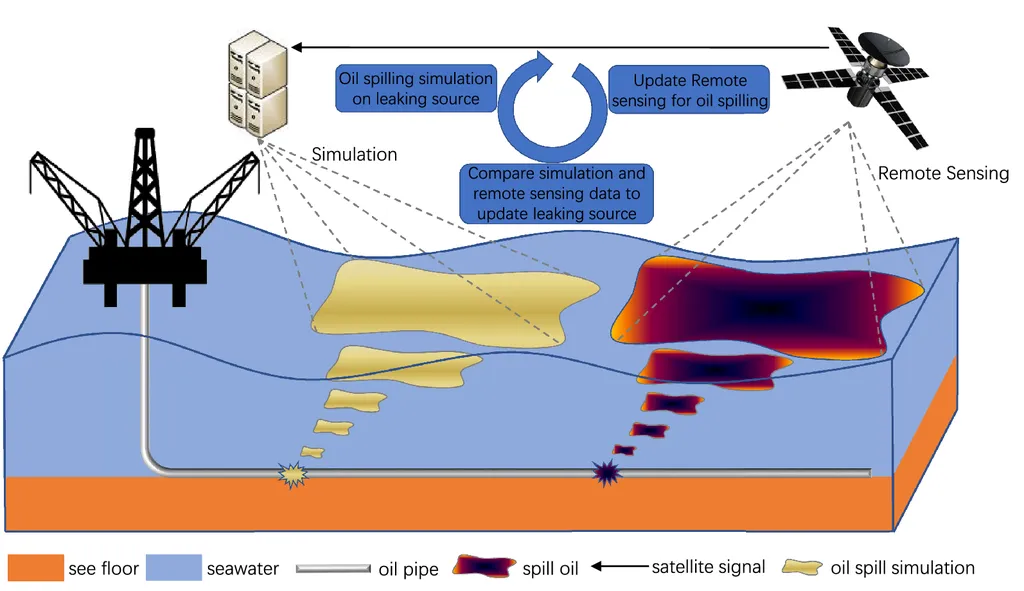
In the realm of environmental monitoring and energy industry safety, rapid and accurate detection of marine oil spills is crucial to minimize ecological and economic damage. A team of researchers from the University of Chinese Academy of Sciences, led by Chenyang Lai, has developed a novel approach to improve oil spill detection using Synthetic Aperture Radar (SAR) imagery. Their work, published in the journal IEEE Transactions on Geoscience and Remote Sensing, introduces a new framework that aims to reduce false positives and enhance the reliability of oil spill monitoring.
Current methods for detecting oil spills using SAR imagery often rely on deep learning-based segmentation of single images. However, these static approaches can struggle to differentiate between true oil spills and other similar oceanic features, such as biogenic slicks or low-wind zones. This can lead to high false positive rates and limit the generalizability of these methods, particularly in data-scarce conditions.
To address these challenges, the researchers introduced the Oil Spill Change Detection (OSCD) framework, which focuses on identifying changes between pre- and post-spill SAR images. This bi-temporal approach leverages the fact that oil spills are dynamic events, and changes between images can provide more reliable indicators of their presence.
One of the key innovations of the OSCD framework is the Temporal-Aware Hybrid Inpainting (TAHI) method, which generates synthetic pre-spill images from post-spill SAR data. This is particularly useful when real co-registered pre-spill imagery is not available. TAHI consists of two main components: High-Fidelity Hybrid Inpainting for oil-free reconstruction, and Temporal Realism Enhancement for ensuring radiometric and sea-state consistency between the synthetic pre-spill image and the actual post-spill image.
Using the TAHI framework, the researchers constructed the first OSCD dataset and benchmarked several state-of-the-art change detection models. The results demonstrated that the OSCD approach significantly reduces false positives and improves detection accuracy compared to conventional segmentation methods. This suggests that temporally-aware methods could play a valuable role in enhancing the reliability and scalability of oil spill monitoring in real-world scenarios.
For the energy industry, this research offers a promising avenue for improving oil spill detection and response efforts. By providing more accurate and reliable monitoring capabilities, the OSCD framework could help energy companies minimize the environmental and economic impacts of marine oil spills, ultimately contributing to safer and more sustainable energy operations.
The research was published in IEEE Transactions on Geoscience and Remote Sensing, a prestigious journal in the field of remote sensing and geoscience. The work represents a significant step forward in the application of advanced imaging techniques to environmental monitoring and energy industry safety.
This article is based on research available at arXiv.