
In the realm of industrial internet of things (IIoT) and energy infrastructure, maintaining system safety, reliability, and efficiency is paramount. Researchers Mohammed Ayalew Belay, Adil Rasheed, and Pierluigi Salvo Rossi from the University of Oulu in Finland have been exploring innovative ways to enhance anomaly detection in industrial systems, a critical task for preventing equipment failures and ensuring smooth operations.
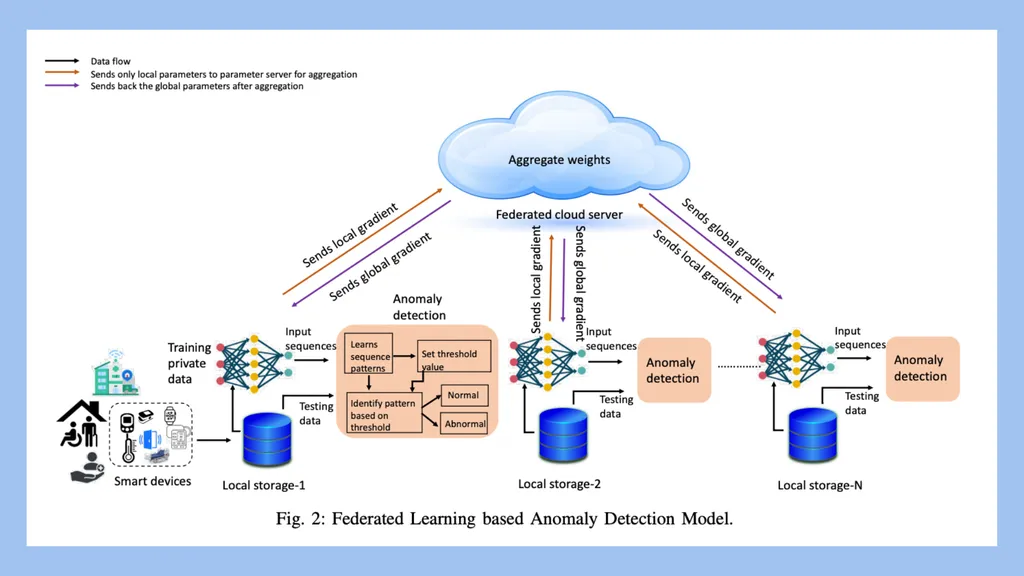
The team has developed a suite of digital twin-integrated federated learning (DTFL) methods designed to improve global model performance while preserving data privacy and communication efficiency. Their work addresses several challenges faced by current statistical and machine-learning methods, such as dependence on real sensor datasets, limited labeled data, high false alarm rates, and privacy concerns.
Digital twins, virtual replicas of physical systems, are used to generate synthetic data that complements real-world data. Federated learning, on the other hand, is a decentralized approach to machine learning where models are trained on multiple devices or servers holding local data samples, without exchanging their data. The researchers combined these two technologies to create five novel approaches: Digital Twin-Based Meta-Learning (DTML), Federated Parameter Fusion (FPF), Layer-wise Parameter Exchange (LPE), Cyclic Weight Adaptation (CWA), and Digital Twin Knowledge Distillation (DTKD).
Each method introduces a unique mechanism to combine synthetic and real-world knowledge, balancing generalization with communication overhead. For instance, CWA periodically adapts the model’s weights based on digital twin data, while FPF fuses parameters from different models to improve performance. The researchers found that these methods significantly accelerate convergence to operationally meaningful accuracy thresholds for IIoT anomaly detection.
In their experiments using a publicly available cyber-physical anomaly detection dataset, the researchers demonstrated substantial communication-efficiency gains. For a target accuracy of 80%, CWA reached the target in 33 rounds, FPF in 41 rounds, and LPE in 48 rounds. DTML took 87 rounds, while the standard FedAvg baseline and DTKD did not reach the target within 100 rounds. These results highlight the potential of DTFL methods to enhance anomaly detection in industrial systems, including those in the energy sector.
Practical applications for the energy industry include predictive maintenance of power plants, early detection of equipment failures in renewable energy systems, and enhancing the security of energy infrastructure. By improving anomaly detection, these methods can help prevent costly downtimes, reduce maintenance costs, and ensure the safe and efficient operation of energy systems. The research was published in the IEEE Internet of Things Journal, a reputable source for advancements in IoT technologies.
This article is based on research available at arXiv.