
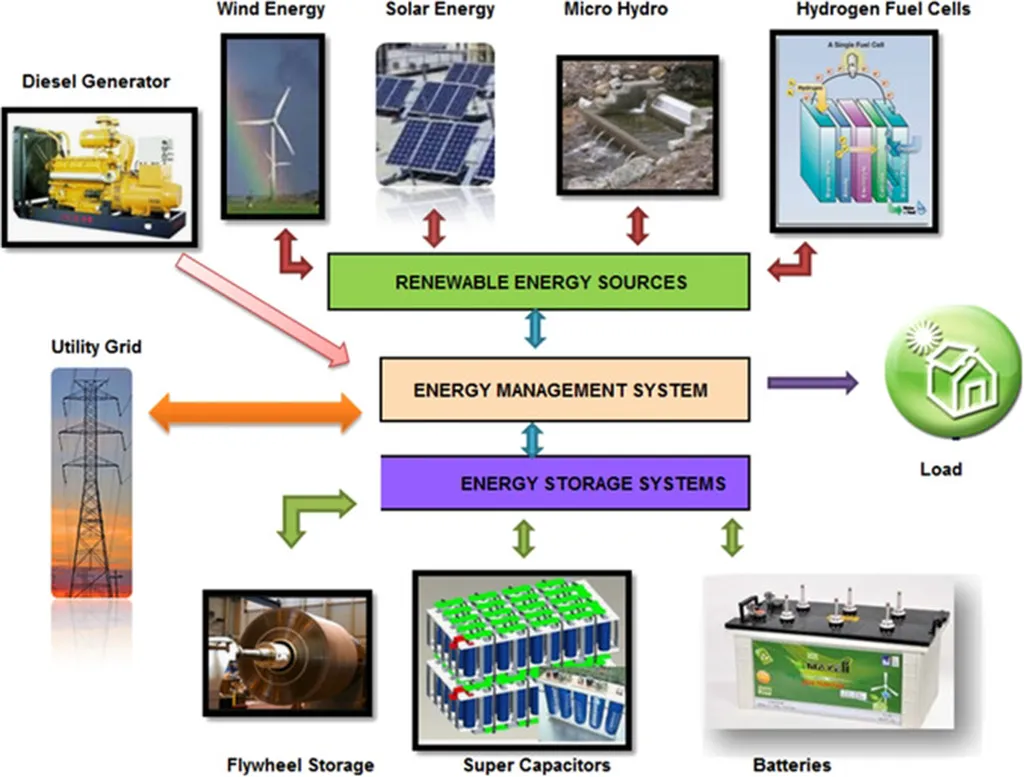
A team of researchers from Aalborg University, including Qingzuo Meng, Pengfeng Lin, Yujie Wang, Miao Zhu, Amer M. Ghias, Syed Islam, and Frede Blaabjerg, has developed a new power management strategy for hybrid AC/DC microgrids with distributed energy storage. Their work, published in the IEEE Transactions on Power Electronics, aims to improve power reliability in remote areas by addressing key challenges in managing these complex systems.
Hybrid AC/DC microgrids combine alternating current (AC) and direct current (DC) systems and often incorporate distributed energy storage to enhance power reliability, particularly in remote areas. Existing power management methods typically focus on either steady-state power sharing or transient inertia support, but rarely combine both. Additionally, they often overlook frequency and voltage deviations caused by droop control, which can negatively impact sensitive loads.
To address these issues, the researchers propose a full-time-scale (FTS) power management strategy. This approach unifies transient inertia sharing and steady-state power allocation through a novel dynamic concatenator. The strategy also introduces autonomous frequency and voltage restoration to eliminate steady-state deviations in each subgrid. Furthermore, the team developed a global equivalent circuit model (GECM) to simplify system analysis and design.
Experiments confirmed that the FTS strategy maintains nominal frequency and voltage in steady state while enabling seamless transition between transient inertia support and proportional power sharing across all time scales. This advancement could significantly enhance the performance and reliability of hybrid AC/DC microgrids, making them more suitable for remote and sensitive applications.
For the energy industry, this research offers a practical solution for managing complex microgrids with both AC and DC components. By improving power reliability and reducing voltage and frequency deviations, this strategy can support the integration of renewable energy sources and enhance the overall stability of the grid. The GECM model also provides a valuable tool for system analysis and design, potentially accelerating the deployment of advanced microgrid technologies.
The research was published in the IEEE Transactions on Power Electronics, a reputable journal in the field of power electronics and energy systems. This publication ensures that the findings are accessible to industry professionals and researchers, facilitating further advancements in microgrid technology.
In summary, the proposed FTS power management strategy represents a significant step forward in the management of hybrid AC/DC microgrids. By addressing key challenges and improving system performance, this approach can contribute to the broader adoption of microgrids in remote and sensitive applications, ultimately enhancing the reliability and sustainability of the energy sector.
This article is based on research available at arXiv.