
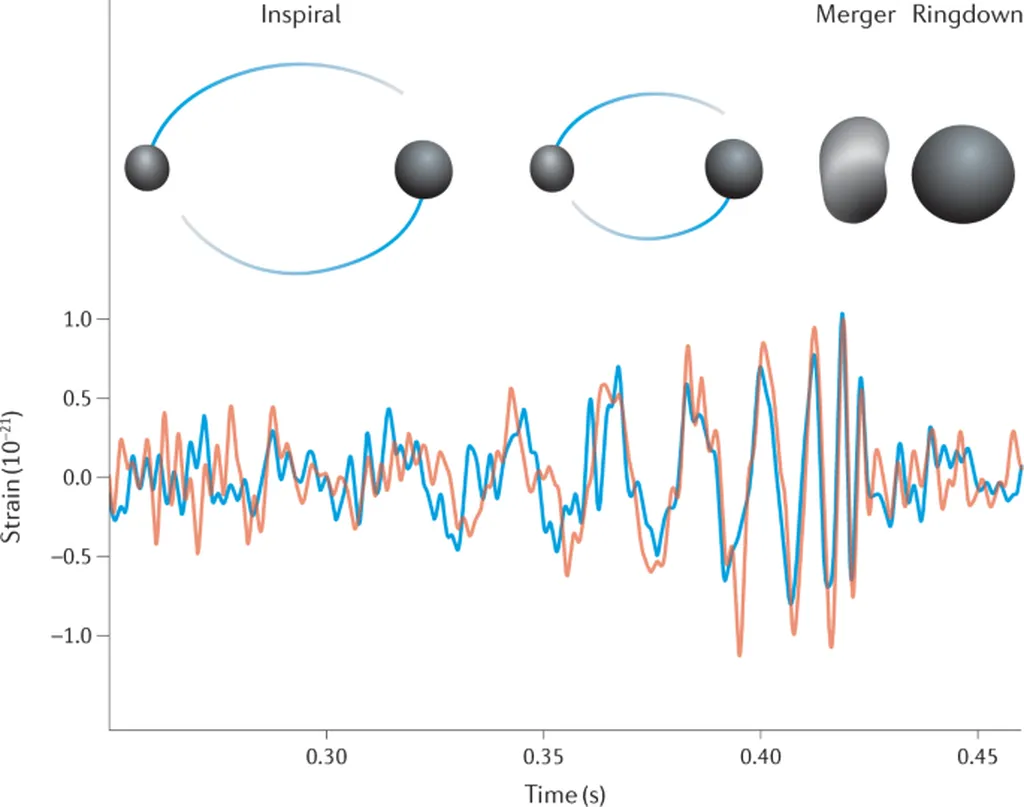
Quentin Henry, a researcher from the Observatoire de Paris, has delved into the intricate dynamics of compact binary systems, such as neutron star or black hole pairs, in a recent study. His work focuses on understanding the gravitational waves emitted by these systems, particularly when their orbits are not perfectly circular but slightly eccentric, and when the effects of the stars’ internal structure, or “tides,” come into play.
In his research, Henry has calculated the gravitational fluxes and waveforms for these eccentric compact binaries, considering the effects of tides within the post-Newtonian approximation. This approximation is a method used to describe the dynamics of these systems, accounting for the effects of gravity that go beyond the well-known Newtonian gravity. Specifically, Henry’s calculations are performed at the relative 2.5 Post-Newtonian (PN) order, which is a high level of precision in these calculations.
The study first derives the radiated energy and angular momentum from these systems, which are crucial for understanding how the orbits of these binaries evolve over time. From these calculations, Henry deduces the equations that describe the long-term, or “secular,” evolution of the orbital elements. By numerically solving these equations for various systems, he finds that the eccentric corrections to the tidal terms can induce a dephasing in the gravitational waves. This dephasing could potentially be detectable in certain regions of the parameter space of gravitational wave sources, providing a new way to probe the internal structure of neutron stars and black holes.
Furthermore, Henry computes the amplitude of the strain in the gravitational waves, decomposed into spin-weighted spherical harmonics. This decomposition is essential for understanding how the gravitational waves interact with detectors like LIGO and Virgo. The study provides the amplitude modes containing the instantaneous, tail, and post-adiabatic corrections expanded to the twelfth order in eccentricity. The memory contributions, which are effects that leave a permanent imprint on the gravitational wave signal, are left for future works.
The results of this study are highly relevant for the energy sector, particularly for companies involved in gravitational wave detection and analysis. Understanding the intricate details of gravitational wave signals from compact binaries can improve the sensitivity and accuracy of gravitational wave detectors. This, in turn, can enhance our ability to probe the fundamental physics of neutron stars and black holes, and potentially unlock new sources of energy and power generation.
The research was published in the journal Physical Review D, a prestigious journal in the field of theoretical and particle physics. The detailed calculations and results are provided in an ancillary file, making it a valuable resource for researchers and professionals in the energy sector.
This article is based on research available at arXiv.