
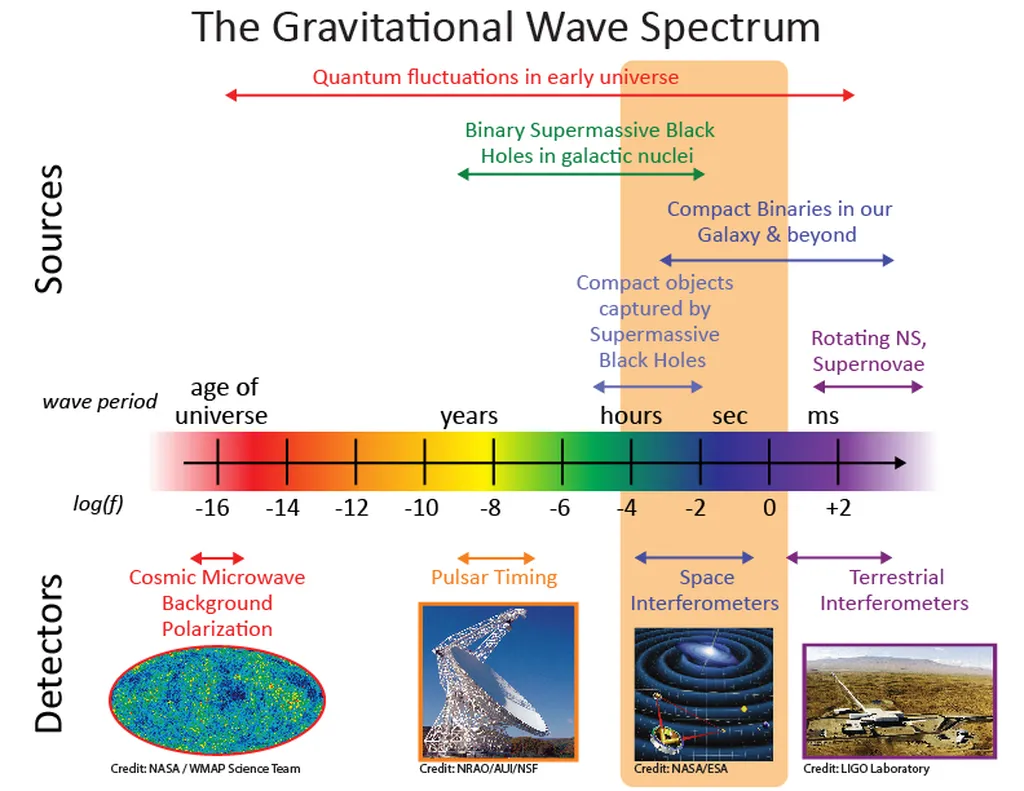
In the realm of theoretical physics and cosmology, a team of researchers from Baylor University has been delving into the intricacies of gravitational waves and their polarizations within the framework of metric f(R) gravity. The team, comprising Ramesh Radhakrishnan, David McNutt, Delaram Mirfendereski, Alejandro Pinero, Eric Davis, William Julius, and Gerald Cleaver, has recently published their findings in a study that sheds light on the potential implications for our understanding of the universe’s evolution and gravitational wave detection.
The researchers focused on the modified Starobinsky model, a specific type of metric f(R) gravity that provides a consistent deSitter background for both early and late-time cosmology. By linearizing the field equations around this background, they derived the Klein Gordon equation for the curvature perturbation, revealing that the scalar propagating mode acquires a mass. This finding underscores the role of the same scalar degree of freedom in governing both inflationary dynamics at high curvature and the propagation of gravitational waves in the current accelerating universe.
Using the scalar-vector-tensor (SVT) decomposition and a decomposition of the perturbed Ricci tensor, the team obtained a set of fully gauge-invariant propagation equations. These equations isolate the contributions of the scalar, vector, and tensor modes in the presence of matter. The study found that the tensor sector retains the two transverse traceless polarizations of General Relativity, while the scalar sector supports a massive breathing-longitudinal mode determined by the massive scalar propagating mode.
Through the geodesic deviation equation, computed both in a local Minkowski patch and in fully covariant deSitter form, the researchers independently recovered the same polarization content and identified its tidal signatures. The resulting framework connects the extra scalar polarization to cosmological observables, providing a unified, gauge-invariant link between gravitational wave phenomenology and the cosmological implications of metric f(R) gravity.
For the energy sector, this research could have significant implications for understanding the fundamental nature of gravitational waves and their interactions with matter. As gravitational wave detectors become more sophisticated, the ability to distinguish between different polarization modes could enhance our ability to probe the universe’s structure and evolution. This, in turn, could lead to more accurate models of cosmic expansion and the distribution of dark matter and dark energy, which are critical for understanding the long-term behavior of the universe and the energy dynamics within it.
The study, titled “Gauge-Invariant Gravitational Wave Polarization in Metric f(R) Gravity with Cosmological Implications,” was published in the journal Physical Review D. The research provides a robust theoretical foundation for future investigations into the interplay between gravitational waves and cosmology, potentially opening new avenues for exploration in the energy sector.
This article is based on research available at arXiv.