
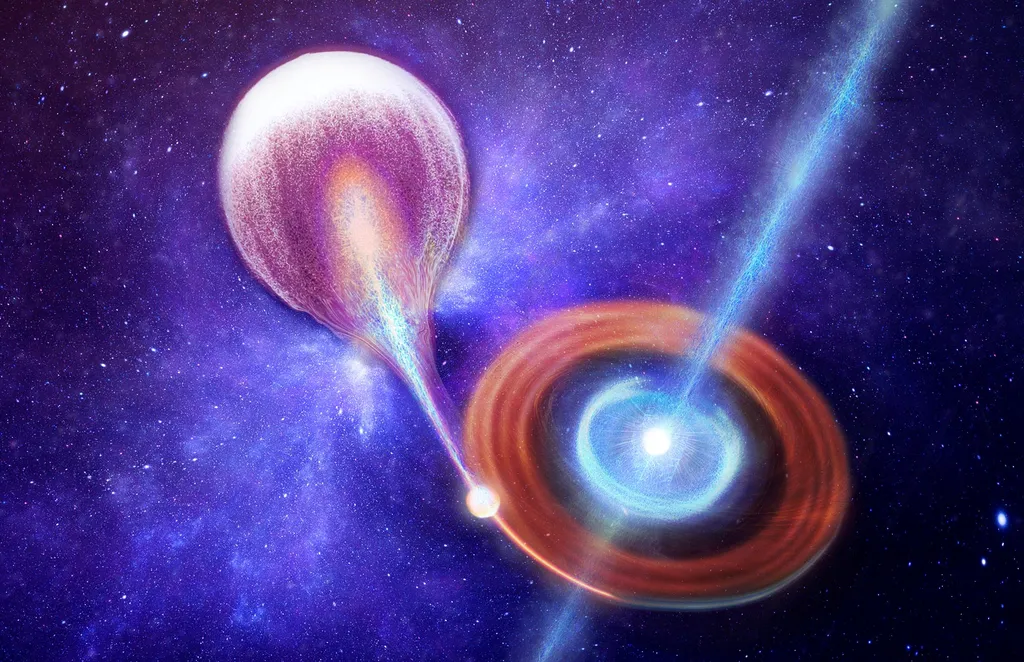
In the realm of high-energy astrophysics, a team of researchers from the Institute of High Energy Physics at the Chinese Academy of Sciences, led by Haojia Xia and Shichuan Chen, has revisited a longstanding question: what powers the intense bursts of energy known as short gamma-ray bursts (sGRBs) that occur during binary neutron star (BNS) mergers? Their findings, published in the journal Physical Review Letters, challenge conventional wisdom and offer a new perspective on the energy dynamics of these cosmic events.
The central engine driving sGRBs has typically been attributed to a black hole surrounded by an accretion disk. However, the researchers explored an alternative hypothesis: the ergostar. An ergostar is a rapidly rotating star with an ergoregion, a region where spacetime is dragged around so rapidly that it’s impossible to stand still. Previous studies using conventional neutron star equations of state (EOSs) suggested that dynamically stable ergostars are unlikely to exist, casting doubt on their astrophysical relevance.
The team, however, approached this problem differently. They used a phenomenological EOS of strangeon matter, a type of exotic matter composed of nucleon-like units for three flavors of quarks. By constructing a large suite of uniformly rotating equilibrium models, they systematically investigated the parameter space of stable ergostars and calculated their maximum extractable energy.
Their findings were striking. Unlike conventional EOSs, strangeon matter supports a vast and robust parameter space for dynamically stable ergostars, even without requiring differential rotation. The extractable rotational energy from these configurations can be on the order of 0.01 solar masses, a reservoir sufficient to power a typical sGRB.
The implications for the energy sector, particularly in the realm of nuclear energy and advanced propulsion systems, are intriguing. Understanding the dynamics of exotic matter and the vast energies involved in sGRBs could potentially inspire new approaches to energy generation and utilization. While direct applications may be far off, the research underscores the importance of exploring unconventional ideas and exotic states of matter to push the boundaries of our energy technologies.
In conclusion, the study revitalizes the ergostar hypothesis as a viable central engine for sGRBs, suggesting that BNS merger remnants composed of exotic matter could play a crucial, previously underestimated role in high-energy astrophysics. The research was published in Physical Review Letters, a prestigious journal in the field of physics.
This article is based on research available at arXiv.