
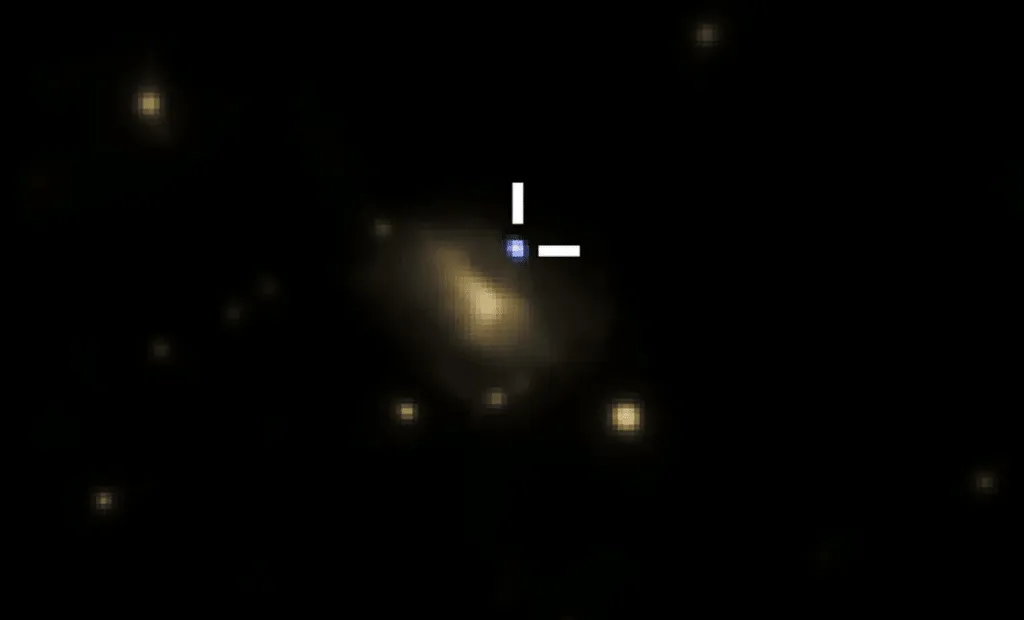
In the realm of astrophysical phenomena, understanding the behavior of luminous transients is crucial for energy researchers, as these events can provide insights into extreme energy processes and potential energy sources. Olivia Aspegren and Daniel Kasen, researchers from the University of California, Berkeley, have delved into the puzzling absence of spectral lines in certain luminous fast blue optical transients (LFBOTs) and tidal disruption events (TDEs). Their work, published in the Astrophysical Journal, offers a framework to understand these featureless spectra and their implications.
The researchers explored the conditions under which hydrogen, helium I, and helium II emission lines form in these transients. They found that high luminosities and compact ejecta radii can lead to featureless spectra. This is due to the high temperature and ionization state of the emitting medium, which suppresses the formation of distinct spectral lines. In contrast, intermediate luminosities and moderately compact systems can produce helium II-dominated spectra, while lower luminosities and more extended atmospheres result in prominent hydrogen and helium I emission lines.
The study also highlighted that large expansion velocities can broaden spectral lines to the point where they blend into the continuum, contributing to the featureless appearance of the spectra. For ultraviolet spectra, even more extreme ionization conditions or velocities are required to suppress the many strong metal lines typically present at these wavelengths.
The practical applications of this research for the energy sector are primarily in the realm of fundamental understanding. By comprehending the conditions that lead to featureless spectra in luminous transients, researchers can gain insights into the extreme energy processes that drive these events. This knowledge can contribute to the broader understanding of energy generation and transfer in the universe, potentially informing the development of new energy technologies or improving existing ones.
In summary, Aspegren and Kasen’s work provides a valuable framework for understanding the absence of spectral lines in certain luminous transients. Their findings, published in the Astrophysical Journal, offer insights into the extreme energy processes that shape these phenomena, contributing to the broader understanding of energy dynamics in the universe.
This article is based on research available at arXiv.