
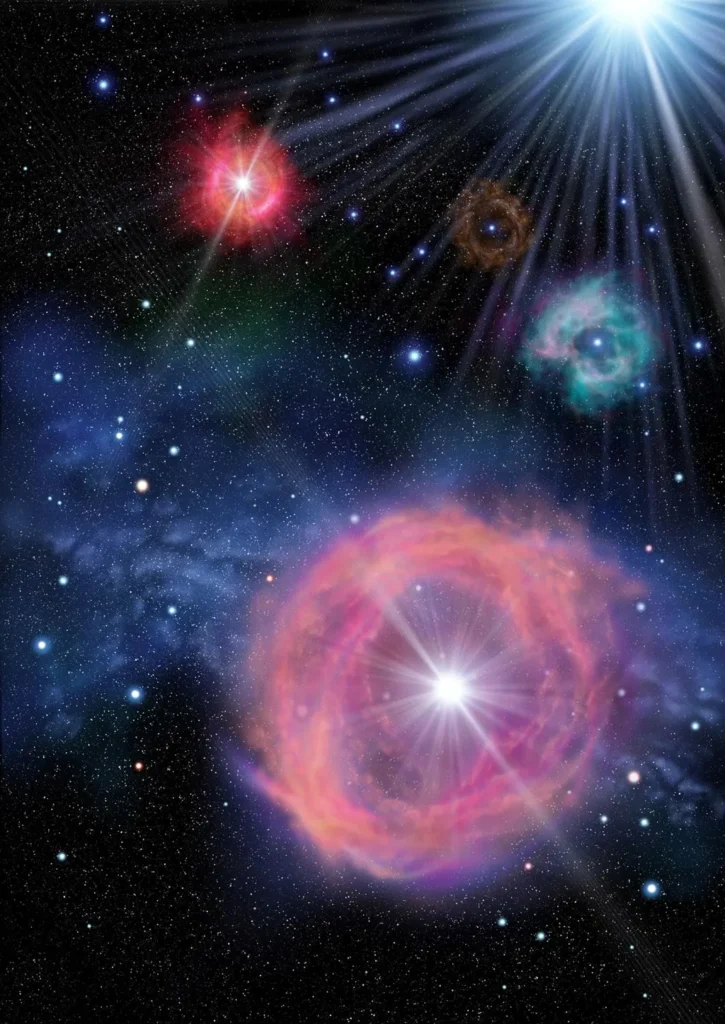
In the vast expanse of the cosmos, supernovae serve as celestial beacons, illuminating the mysteries of stellar evolution and death. Researchers from the Kavli Institute for Astronomy and Astrophysics at Peking University, along with collaborators from the University of California, Berkeley, and other institutions, have recently turned their gaze towards a peculiar supernova, designated SN 2024abvb. This stellar explosion, observed in the outskirts of its host galaxy, has provided valuable insights into a rare subclass of supernovae known as Type Icn.
The team, led by Maokai Hu and Shengyu Yan, presented their findings in a study published in the Astrophysical Journal. The researchers conducted multiband photometric and spectroscopic observations of SN 2024abvb, noting its early-time prominent photoionized narrow emission lines of carbon superposed on a blue continuum. The absence of Balmer features indicated that the supernova exploded within hydrogen-poor circumstellar matter (CSM), and the lack of explicit evidence of helium signatures led the team to tentatively identify SN 2024abvb as a Type Icn supernova.
After correcting for extinction, the researchers estimated an r-band peak absolute magnitude of -19.7, placing SN 2024abvb in the luminous regime of Type Icn supernovae. To model the light curve of SN 2024abvb, the team adopted a hybrid model that accounts for both the energy released by the ejecta-CSM interaction and the radioactive decay of nickel synthesized in the supernova ejecta. The best-fit model to the multiband light curves within the first approximately 40 days after the explosion suggested that the CSM, radioactive nickel, and ejecta masses were 0.28 solar masses, 3.54 times 10^-3 solar masses, and 0.12 solar masses, respectively.
The low ejecta mass indicated that the progenitor star of SN 2024abvb experienced significant mass-stripping processes, consistent with the hydrogen-poor and helium-poor spectral features. This finding provides important insights into the physical origins of the rare subclass of Type Icn supernovae. While the direct implications for the energy sector may not be immediately apparent, understanding the life cycles of stars and the elements they produce is crucial for comprehending the broader context of the universe’s energy dynamics. The study of supernovae contributes to our knowledge of nucleosynthesis, the process by which elements heavier than hydrogen and helium are created. This, in turn, enhances our understanding of the cosmic origins of elements essential for energy technologies, such as silicon for solar panels and lithium for batteries.
This article is based on research available at arXiv.