
Researchers from the University of Hong Kong, led by Joey Chan and Huan Wang, have developed a novel approach to predict battery degradation across various chemistries and conditions. Their work aims to improve the safety, reliability, and efficiency of energy storage systems, which are crucial for the energy industry.
The team has created a unified framework for forecasting battery capacity fade, a significant challenge due to the diversity of cell chemistries, forms, and operating conditions. To tackle this, they compiled a large-scale dataset from 20 public aging datasets, encompassing 1,704 cells and 3,961,195 charge-discharge cycle segments. This dataset spans a wide range of temperatures, charging rates, and usage profiles, including fast charging and partial cycling.
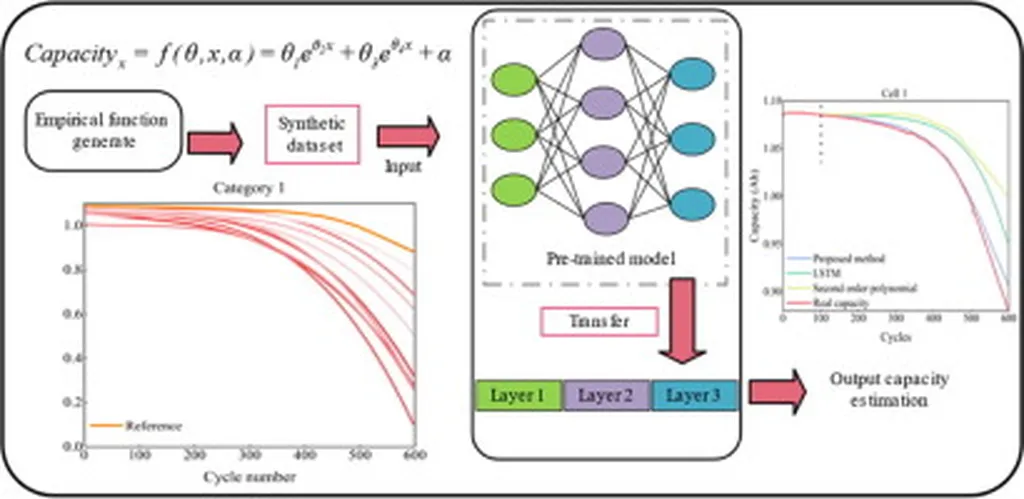
The researchers employed a Time-Series Foundation Model (TSFM) backbone, a type of artificial intelligence model designed to handle sequential data, and combined it with parameter-efficient Low-Rank Adaptation (LoRA) and physics-guided contrastive representation learning. This approach allows the model to capture shared degradation patterns across different battery types and conditions.
The model was tested on both seen and unseen datasets, demonstrating competitive or superior accuracy compared to traditional, per-dataset baselines. Importantly, it maintained stable performance on chemistries, capacity scales, and operating conditions not included in the training data. This indicates that the model can generalize well to new, unseen scenarios, making it a promising solution for real-world battery management systems.
The research, published in the journal Nature Communications, highlights the potential of TSFM-based architectures for scalable and transferable capacity degradation forecasting. This could lead to more accurate battery health monitoring, improved safety, and extended battery life, all of which are critical for the energy industry as it increasingly relies on battery storage technologies.
The researchers’ work is a significant step towards developing universal battery degradation models, which could greatly enhance the performance and reliability of energy storage systems. As the energy industry continues to evolve, such advancements will be crucial in supporting the integration of renewable energy sources and the development of electric vehicles.
Source: Nature Communications
This article is based on research available at arXiv.