
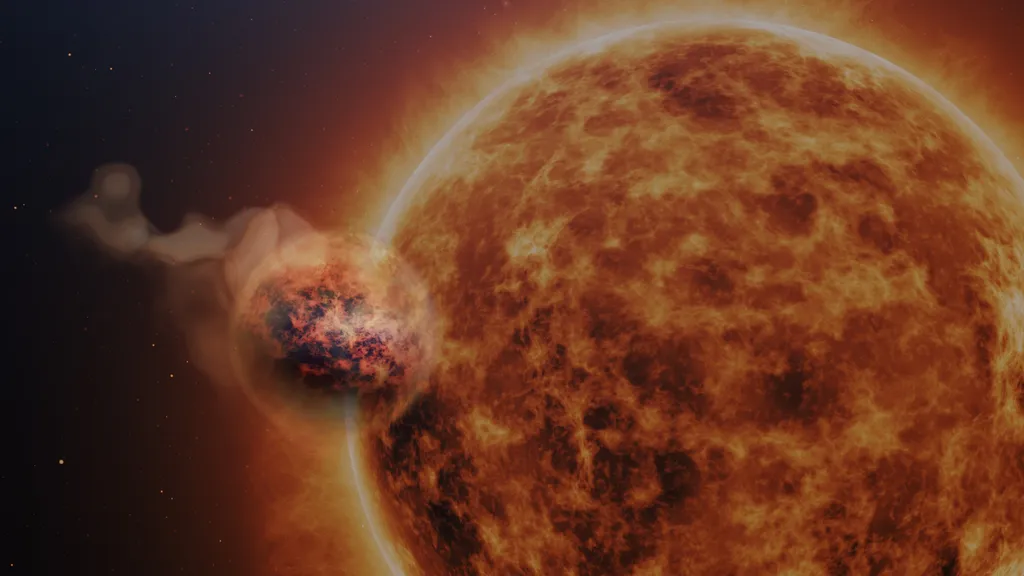
In the realm of exoplanetary research, a team led by Yunke Wu from the University of Arizona has made significant strides in understanding the dynamics of WASP-107 b, an intriguing low-density exoplanet. This research, published in the Astrophysical Journal Letters, offers new insights into the planet’s structure, evolution, and the mechanisms behind its unusual characteristics.
WASP-107 b is a type of exoplanet known as a “super-puff,” characterized by its extremely low density and inflated radius. These features make it a prime target for studying planetary structure and evolution. One critical parameter in understanding WASP-107 b is its orbital eccentricity, which can provide clues about processes like tidal heating and high-eccentricity migration. However, previous measurements have been inconclusive due to the star’s activity and the presence of other planets in the system.
To overcome these challenges, the research team combined new data from the James Webb Space Telescope (JWST) with existing data from the Hubble Space Telescope (HST) and the Transiting Exoplanet Survey Satellite (TESS). By analyzing the secondary eclipse data from JWST and transit timing data from HST and TESS, they were able to measure the eccentricity of WASP-107 b with greater precision.
The findings reveal that WASP-107 b has an eccentricity of approximately 0.09, meaning its orbit is slightly elliptical rather than perfectly circular. This measurement is consistent with the scenario of high-eccentricity migration, where a planet forms with a highly elliptical orbit and gradually circularizes over time. The team also determined the planet’s mass to be about 0.096 times that of Jupiter and its orbital period to be approximately 5.721487 days.
One of the most significant implications of this research is the role of eccentricity-driven tidal dissipation in sustaining the planet’s inflated radius. Tidal forces generated by the planet’s eccentric orbit can dissipate energy within the planet, potentially contributing to its inflated size. This finding offers new insights into the formation and evolution history of WASP-107 b and similar low-density exoplanets.
For the energy sector, understanding the dynamics of exoplanets like WASP-107 b can provide valuable insights into planetary formation and evolution, which in turn can inform our understanding of the potential for habitable planets and the energy sources that might sustain them. While this research is primarily focused on fundamental planetary science, the knowledge gained can contribute to broader discussions about energy and habitability in the universe.
In summary, the research led by Yunke Wu and his team has provided a more precise measurement of the eccentricity of WASP-107 b, shedding light on its formation and evolution. The findings highlight the importance of eccentricity-driven tidal dissipation in sustaining the planet’s inflated radius and offer new avenues for exploring the dynamics of low-density exoplanets.
This article is based on research available at arXiv.