
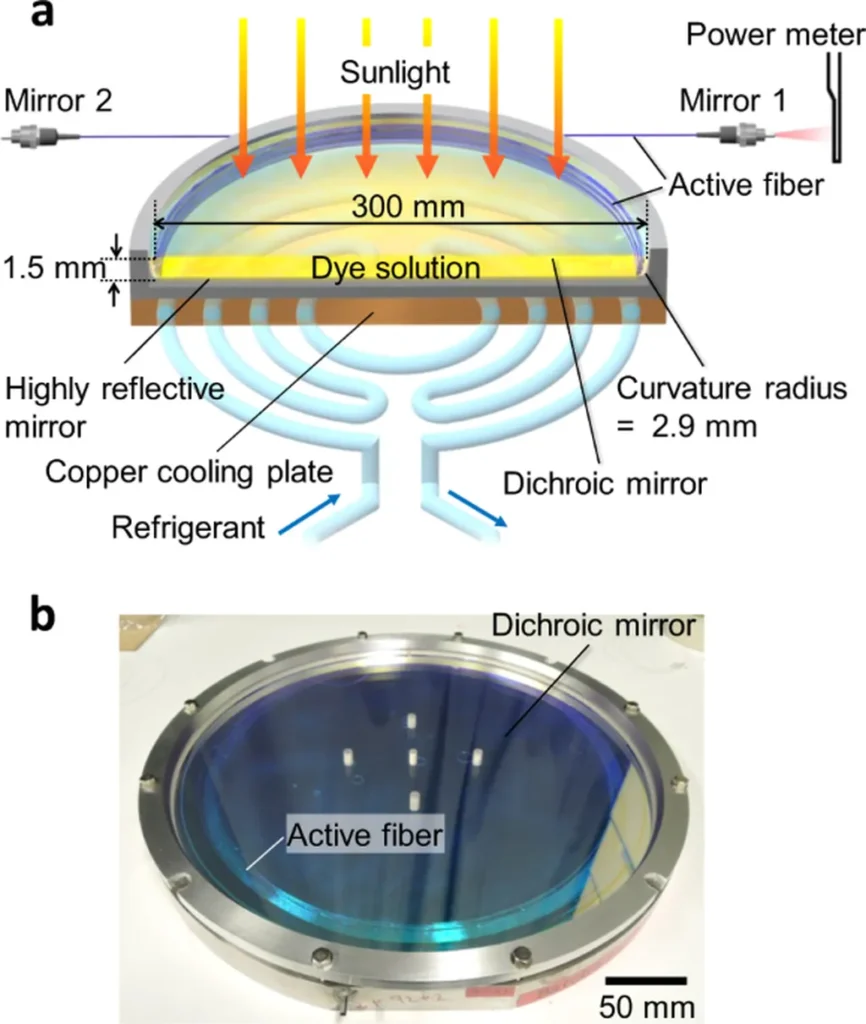
Researchers Michael Küblböck, Mohammad Sahil, and Hanieh Fattahi from the Max Planck Institute for Quantum Optics have made significant strides in the field of solar-pumped lasers, a technology that could have substantial implications for the energy sector. Their work, published in the journal Nature Photonics, focuses on enhancing the performance and scalability of solar-pumped lasers, which convert solar energy into laser light.
Traditional solar-pumped lasers, primarily based on neodymium, have faced challenges related to thermal loading and limited power scalability. These issues have constrained their efficiency and practical applications. The researchers propose a novel design that utilizes an ytterbium thin-disk gain medium combined with a dome concentrator. This configuration allows for multipass solar pumping and enhanced absorption, significantly improving the laser’s performance.
The team’s design achieves comparably low lasing thresholds for both neodymium- and ytterbium-doped media. However, ytterbium offers superior power scalability, enabling up to threefold higher output power. This advancement is crucial for the energy industry, as it paves the way for more efficient and powerful solar-pumped lasers.
One of the most notable achievements of this research is the identification of a solar-pumped, radiation-balanced configuration. This setup, which combines an ytterbium-doped medium with a spherical concentrator, achieves self-cooled lasing at solar pump intensities of 28.5 kW cm-2 within the 1020-1033 nm window of the solar spectrum. The spherical concentrator increases the averaged fluence of the solar pump while allowing anti-Stokes fluorescence to escape efficiently. This self-cooling mechanism is a significant breakthrough, as it eliminates the need for additional cooling systems, reducing complexity and cost.
The practical applications of this research for the energy sector are manifold. Solar-pumped lasers can be used for various purposes, including space-based photonics, remote sensing, and laser-based power transmission. The enhanced performance and scalability of these lasers could make them a more viable and sustainable option for renewable energy conversion and other industrial applications.
In summary, the work of Küblböck, Sahil, and Fattahi represents a significant step forward in the development of solar-pumped lasers. Their innovative design and the achievement of self-cooled lasing could have far-reaching implications for the energy industry, enabling more efficient and sustainable use of solar energy. This research was published in the journal Nature Photonics.
This article is based on research available at arXiv.