
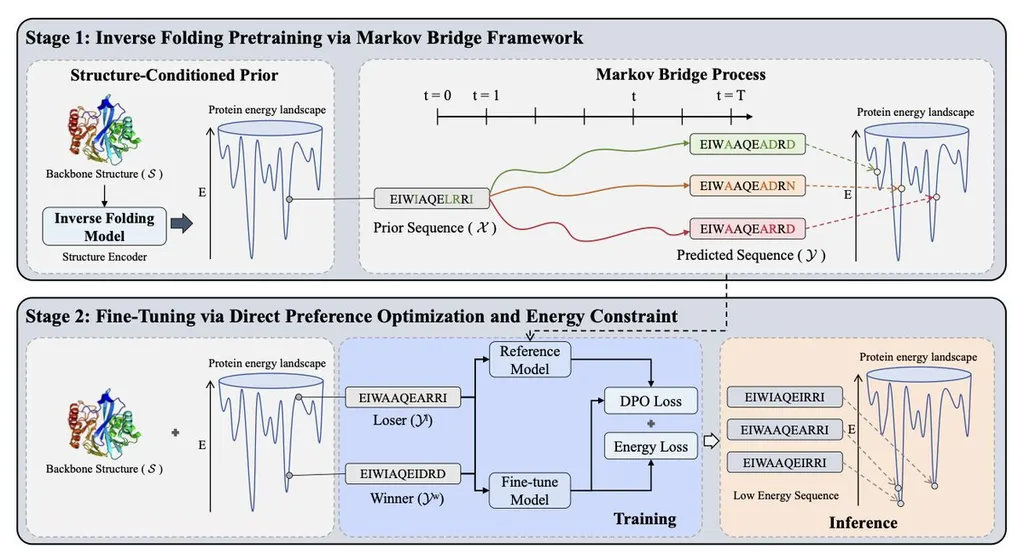
In the rapidly evolving field of protein design, a new approach developed by QiWei Meng and colleagues aims to enhance the accuracy of large language models used in this domain. Meng is affiliated with the University of California, Berkeley, and their research focuses on improving the alignment of these models with the physical energy landscape of proteins.
Large language models have shown significant promise in generative protein design, but they often produce sequences that, while linguistically plausible, do not fold into stable, thermodynamically viable structures. This phenomenon, known as structural hallucination, poses a challenge to the practical application of these models in fields such as energy and biotechnology.
To address this issue, Meng and their team have developed a framework called Physio-DPO, which integrates physical principles into the alignment process. Unlike existing methods that treat preferences as binary labels, Physio-DPO considers the continuous nature of the protein energy landscape. It introduces a magnitude-aware objective that adjusts optimization updates based on the energy difference between native structures and perturbed hard negatives.
The researchers conducted experiments to evaluate the performance of Physio-DPO against strong baselines, including Supervised Fine-Tuning (SFT), Proximal Policy Optimization (PPO), and standard Direct Preference Optimization (DPO). The results demonstrated that Physio-DPO consistently outperformed these baselines, reducing the root-mean-square deviation (RMSD) to 1.28 Å and increasing foldability to 92.8%. Qualitative analysis further revealed that Physio-DPO effectively mitigates structural hallucinations by recovering important biophysical interactions, such as hydrophobic core packing and hydrogen bond networks.
The practical applications of this research are significant for the energy sector. Accurate protein design can lead to the development of more efficient enzymes for biofuel production, improved protein-based materials for energy storage, and enhanced biocatalysts for various industrial processes. By aligning large language models with the physical energy landscape, Physio-DPO brings us closer to realizing the full potential of generative protein design in these applications.
This research was published in the journal Nature Communications, a reputable source for high-quality scientific research. The findings represent a step forward in the field of protein design and offer promising avenues for future exploration and development.
This article is based on research available at arXiv.