
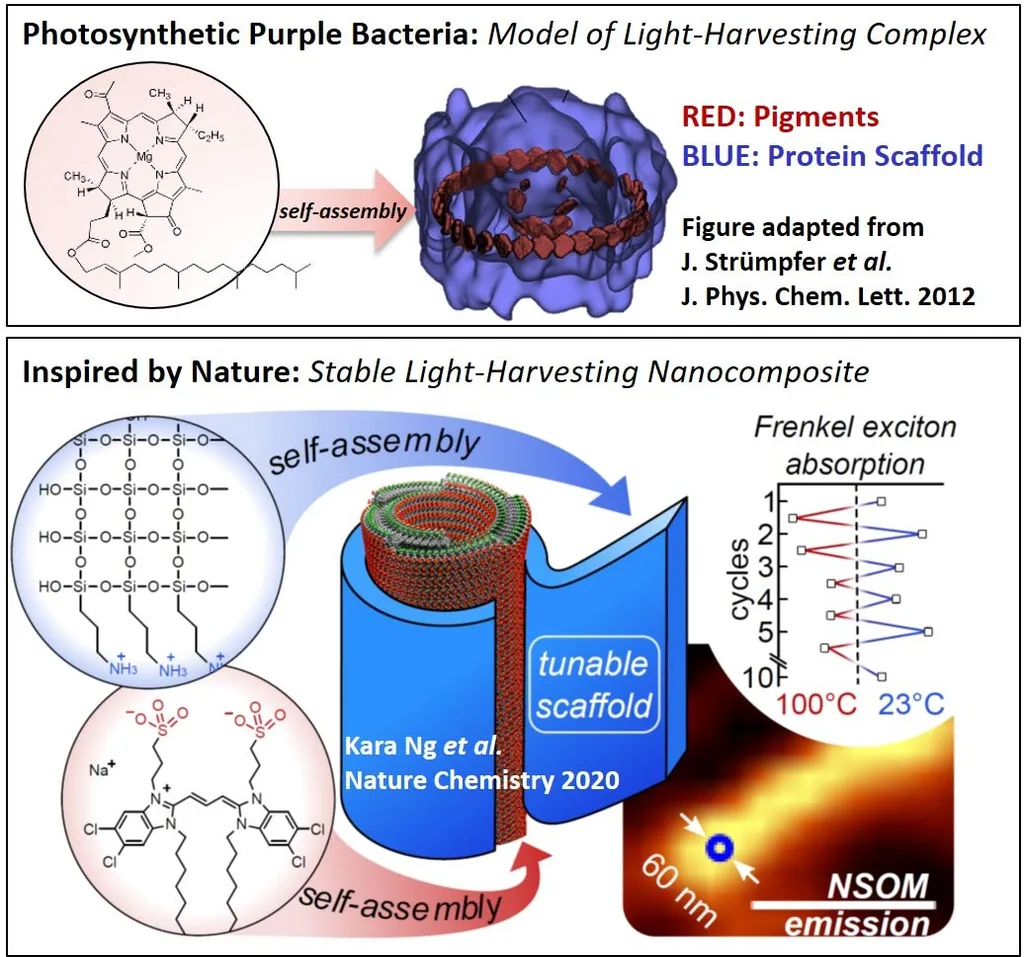
In the realm of energy research, a team of scientists from the University of California, Riverside, led by Daniel Montemayor, Eva Rivera, and Seogjoo J. Jang, have been delving into the intricacies of photosynthetic bacteria. Their work, recently published in the Journal of Physical Chemistry B, focuses on understanding the light-harvesting complexes in purple bacteria, which could potentially inspire more efficient solar energy technologies.
The researchers have been studying two types of light-harvesting complexes, known as LH2 and LH3, found in purple bacteria. These complexes are responsible for absorbing light and transferring the energy to the reaction centers where photosynthesis occurs. The LH2 complex has two major absorption bands, one at 800 nm and another at 850 nm. Interestingly, under low light conditions, some species of purple bacteria replace LH2 with LH3, which has a similar structure but a distinct absorption spectrum. The main difference is that the 850 nm band in LH2 shifts to 820 nm in LH3.
To understand the molecular origins of this spectral shift, the researchers conducted comprehensive computational studies. They performed all-atomistic molecular dynamics simulations of both LH2 and LH3 complexes to identify structural differences, particularly in the patterns of hydrogen bonding and the torsional angles of the acetyl group in the bacterial chlorophylls (BChls). They then used time-dependent density functional theory calculations to determine the excitation energies of the BChls for structures sampled from the molecular dynamics simulations.
The results showed that the observed differences in hydrogen bonding and torsional angles could not fully account for the experimentally observed spectral shift in LH3. The researchers discussed potential sources that could explain the actual spectral shift and assessed their magnitudes through fitting of experimental line shapes. This work provides a deeper understanding of the molecular mechanisms underlying light absorption in photosynthetic bacteria, which could potentially lead to the development of more efficient artificial light-harvesting systems for solar energy conversion.
This article is based on research available at arXiv.